3 scenarios for where sugar factory automation is heading by 2031, and where Sucrosphere fits in each.
The next 5 years will not be a gentle software update to the control room. Too many forces are arriving at the same time: real-time sensing, machine vision, MPC, digital twins, cloud and edge architectures, industrial AI, field-level connectivity, and the demographic reality of retiring experts. Each of these trends would be manageable on its own. Together they change how a sugar factory has to be run.
The conservative view says that sugar factories will modernise slowly: better DCS versions, better historians, more cybersecurity, more remote access, and a few advanced-control pilots. That will happen, but it is not enough to describe the future. Technology adoption is rarely linear when economics become urgent. Once a factory can measure disturbances in real time, predict their impact, and correct them before the lab report arrives, the old operating model starts to look expensive.
The next 5 years are better understood as 3 scenarios. Scenario 1 is the comfort scenario, but also the least realistic one. The real strategic challenge will be between scenario 2 and scenario 3.
Scenario 1: Conservative Evolution
Better Automation, Same Operating Philosophy
In this scenario, most sugar factories continue modernising their existing DCS and PLC systems but remain largely operator-driven. Investments focus on DCS upgrades, cybersecurity, historians, reporting, basic cloud connectivity, and predictive maintenance. The control room looks more modern, but the operating philosophy remains familiar: operators interpret trends, operators decide, operators adjust, and automation executes.
This scenario will exist in some factories, but as a long-term industry path it is the least realistic. It assumes that experienced operators remain available, that energy and margin pressure stay manageable, and that incremental modernisation can close the performance gap. Those assumptions are weak. The knowledge gap is growing, campaigns are unforgiving, and competitors will not wait while others modernise at a comfortable pace.
For Sucrosphere, scenario 1 still creates value: it becomes a high-performance optimisation layer that helps conservative factories extract more from their existing DCS without replacing it. But the impact remains limited if the organisation refuses to move beyond manual decision-making.
| Area | 2031: Conservative Evolution |
|---|---|
| DCS | Still the primary execution and visualisation layer |
| Operators | Control most process decisions manually |
| MPC | Limited to isolated applications or pilot areas |
| Cloud | Mainly reporting, benchmarking, and remote expert support |
| AI | Alarm summaries, reporting assistants, and documentation support |
| Digital twins | Engineering and simulation tools, not yet daily operations |
| Sucrosphere role | Optimisation add-on that proves value but is not yet trusted as the factory intelligence layer |
| Likely result | Incremental improvements, but a growing gap to faster-moving competitors |
Scenario 2: Accelerated Digitalisation
AI-Assisted Operations Become Standard
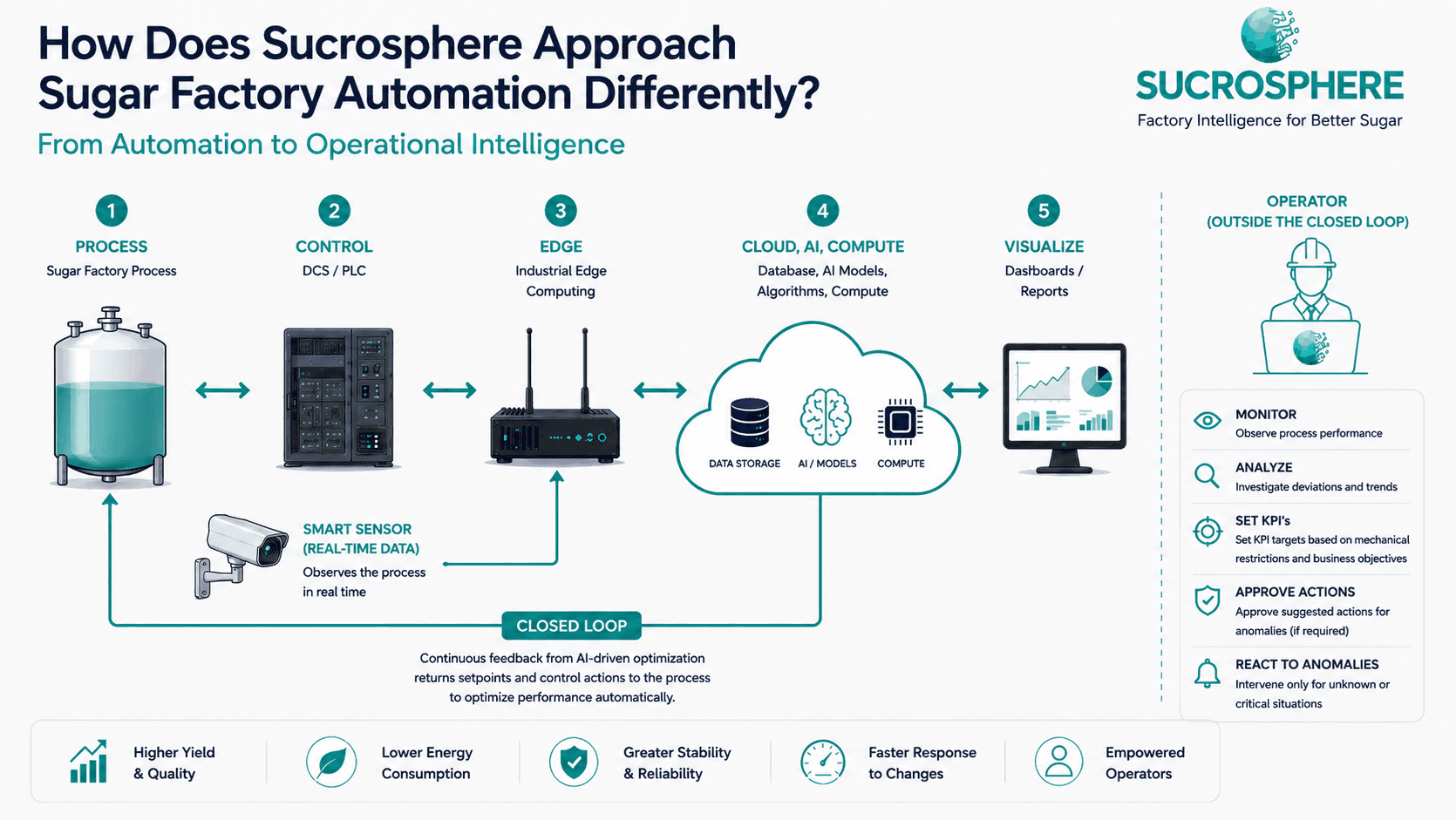
This is the more realistic baseline for leading sugar producers. DCS systems remain the execution layer, because safety, interlocks, and reliable plant control must stay deterministic. But above the DCS, a sugar-specific optimisation layer becomes normal: combining real-time sensors, MPC, digital twins, cloud analytics, and industrial AI.
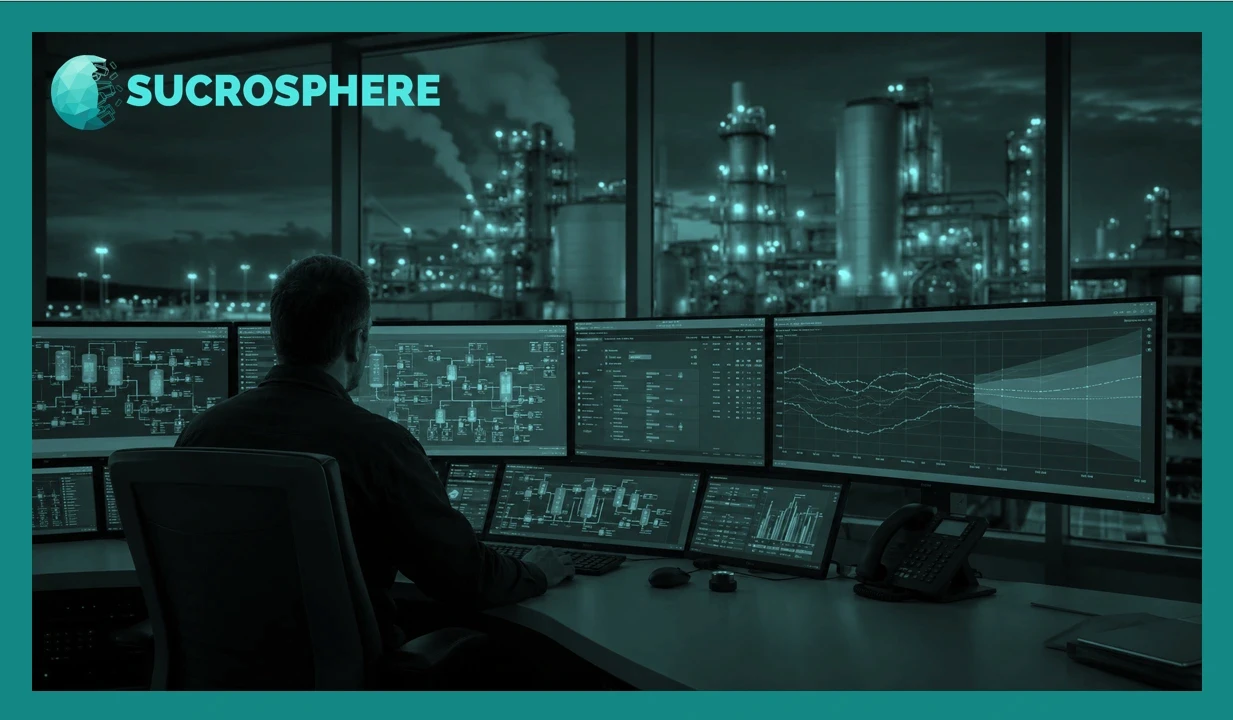
The production team does not disappear. Its role changes. Operators no longer spend their whole shift chasing deviations after they have already appeared. They supervise recommendations, review explanations, and approve or reject controlled actions within defined guardrails. The central question in the control room changes from 'What should we do now?' to 'Why is the optimiser recommending this action, and what will happen if we accept it?'
In this scenario, Sucrosphere becomes the factory intelligence layer. It connects sensor data, sugar-specific models, MPC, and operator workflows. It helps experienced staff scale their knowledge across shifts and factories, and it helps new operators learn faster because the system explains process behaviour in real time.
This is also the scenario where adoption speed matters most. The technology is not the bottleneck. The bottleneck is trust: trust in the sensors, trust in the model, trust in the recommendations, and trust that the system will support operators rather than expose or replace them.
| Area | 2031: Accelerated Digitalisation |
|---|---|
| DCS | Stable execution platform for safe and deterministic control |
| MPC | Standard in key stations such as extraction, evaporation, crystallisation, and energy balance |
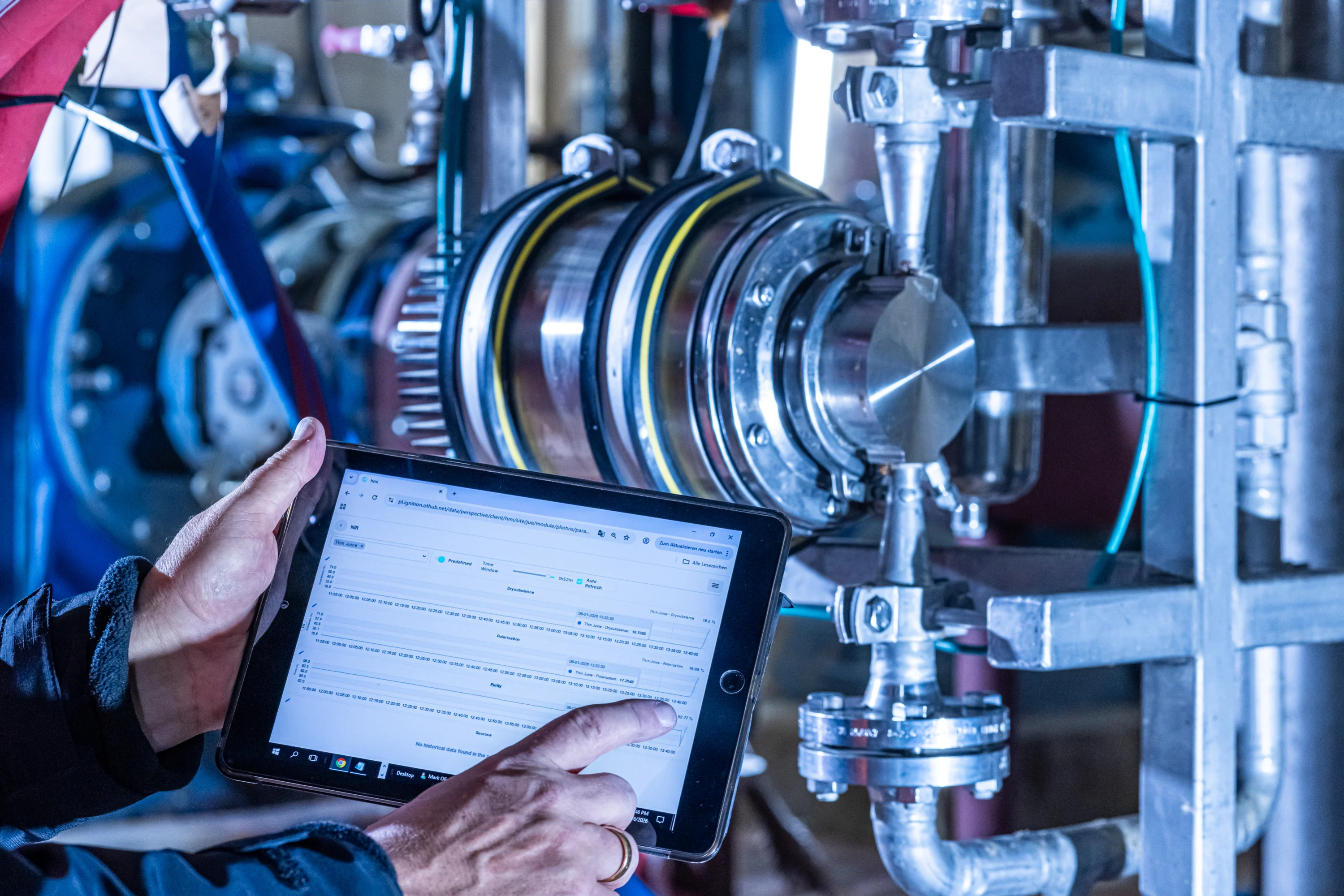
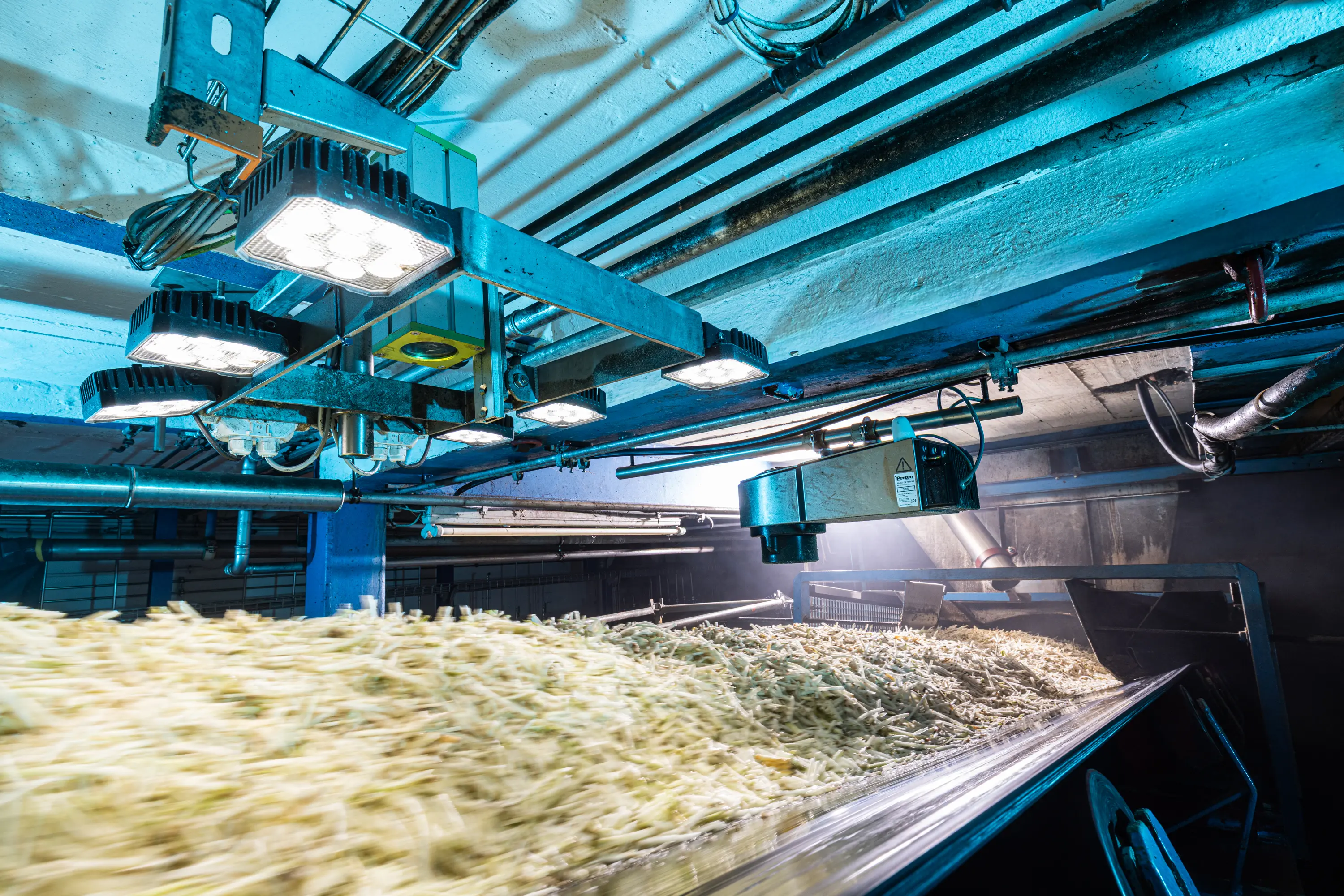
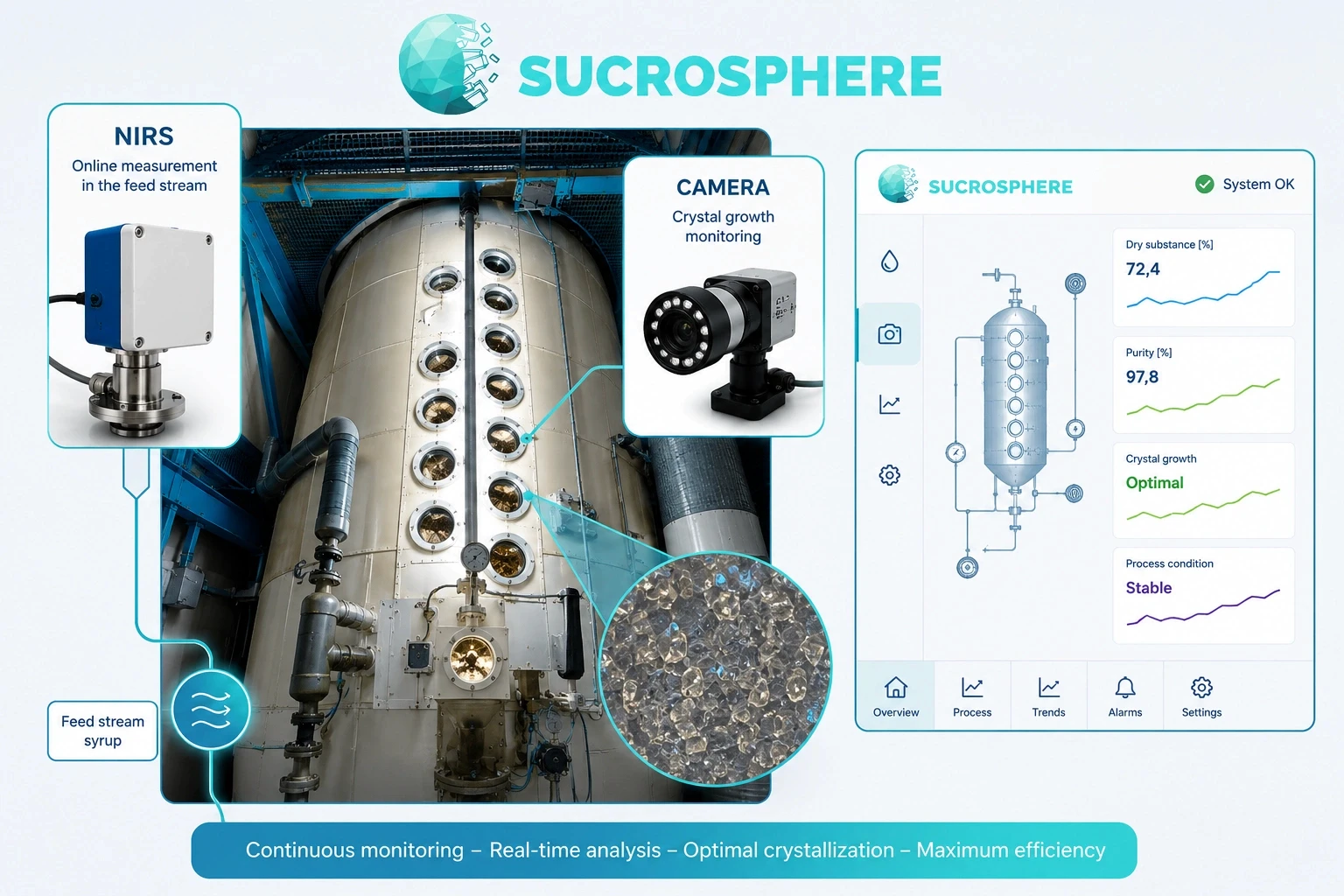
| Sensors | Real-time process visibility through NIR, machine vision, and connected instrumentation |
| AI | Daily operational assistant for explanations, shift handover, anomaly review, and training |
| Cloud | Fleet-wide benchmarking and multi-factory optimisation support |
| Digital twins | Operational decision support and campaign preparation |
| Operators | Supervisors of autonomous recommendations, not passive screen-watchers |
| Sucrosphere role | Factory intelligence layer that turns real-time sugar data into better setpoints and coordinated decisions |
Scenario 3: The Autonomous Sugar Factory
The Factory Becomes Self-Optimising
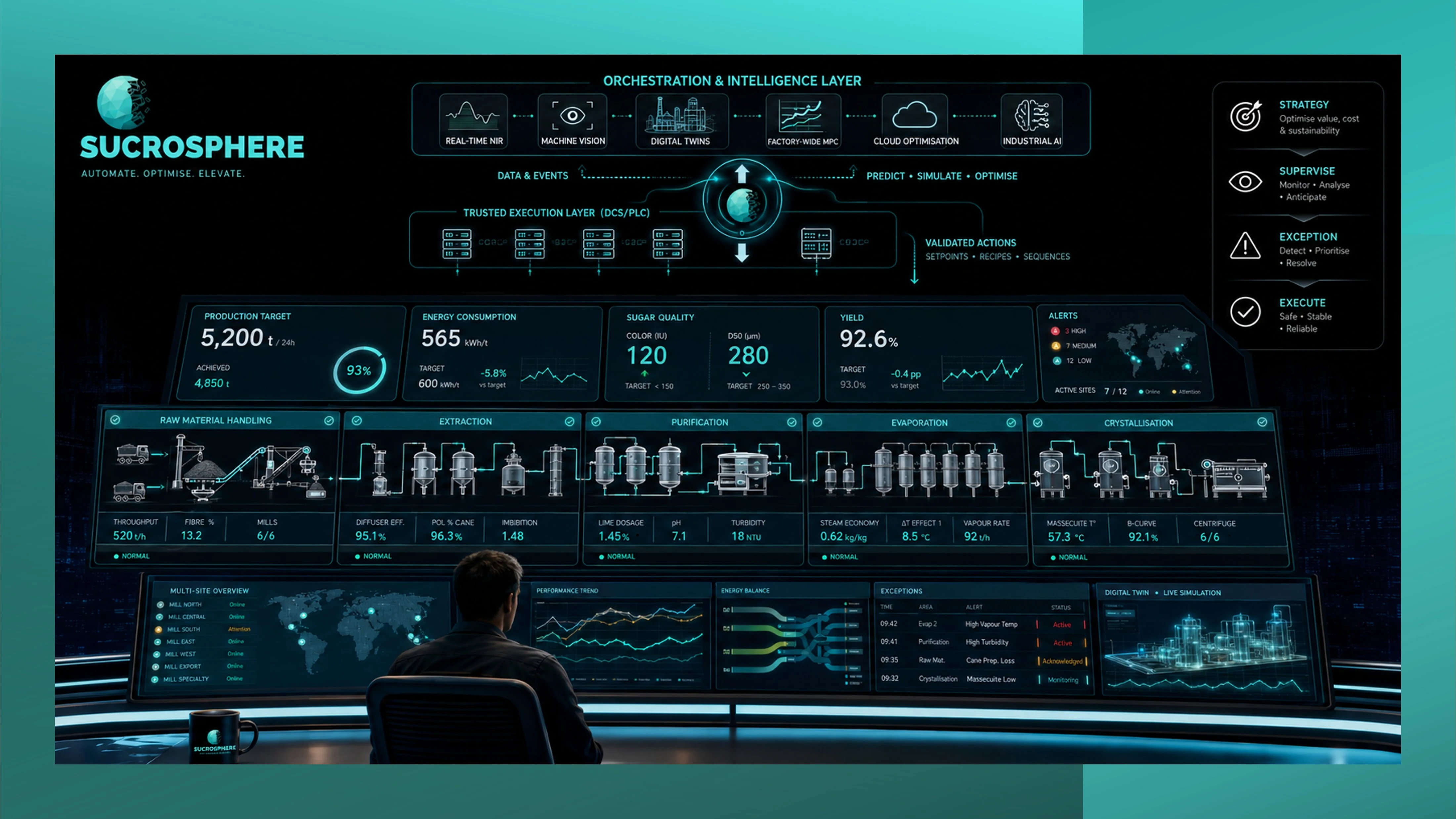
Scenario 3 is the ambitious path. It is not unrealistic, but it requires a different level of organisational commitment. In this scenario, the DCS no longer acts as the intelligence centre. It remains the trusted execution engine, while intelligence moves into an orchestration layer that combines real-time NIR, machine vision, digital twins, factory-wide MPC, cloud optimisation, and industrial AI.
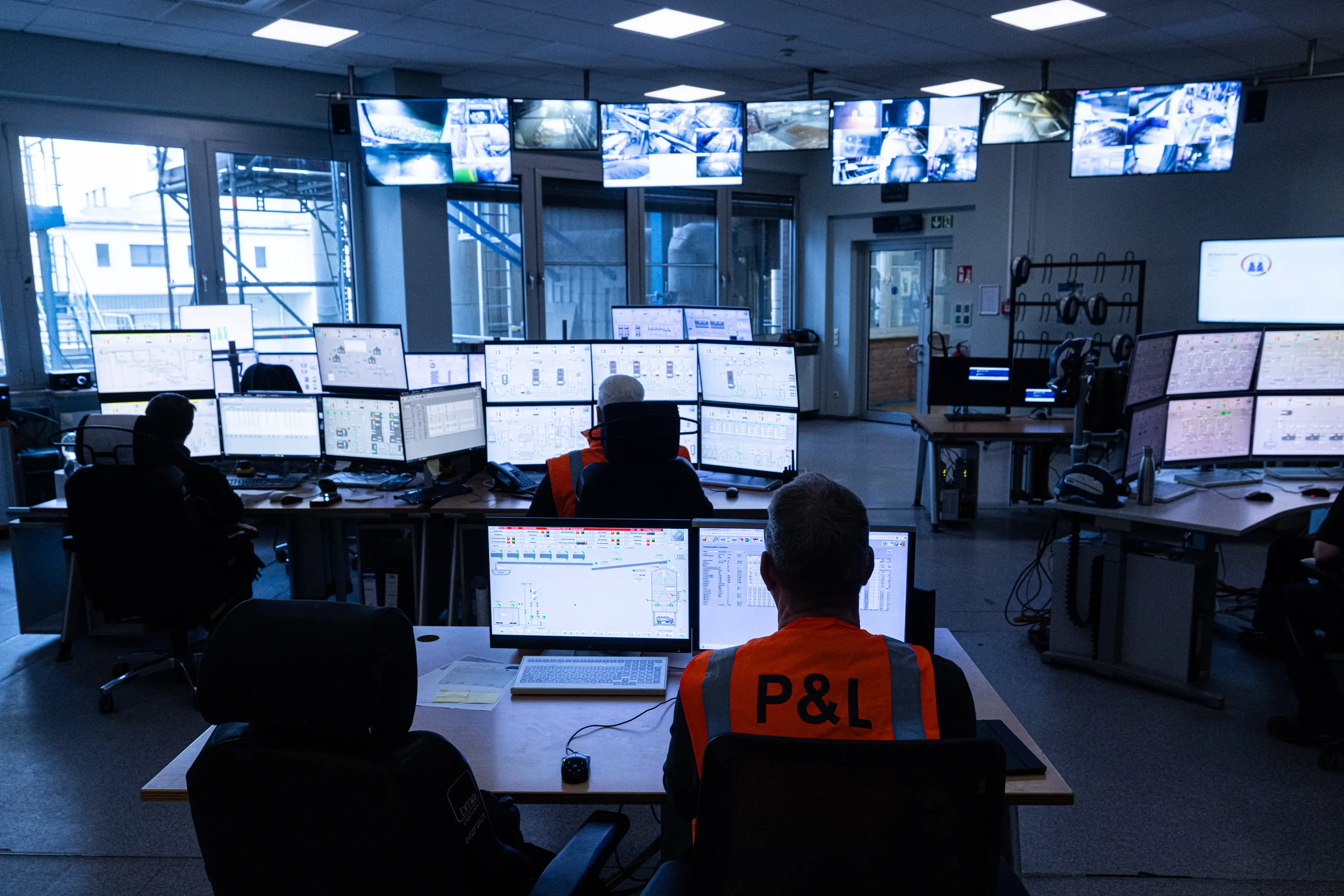
The factory continuously predicts its future state. It sees raw material changes earlier, estimates downstream consequences, simulates alternatives, and executes the best validated action within operational constraints. The control room becomes less a place of manual intervention and more a place of supervision, strategy, and exception handling.
The operator reviews the logic. The MPC executes inside validated boundaries. The digital twin verifies the response. The result is measured. The system learns.
In this scenario, Sucrosphere is the operating system of the autonomous sugar factory: the layer that makes the plant think ahead, coordinate stations, and convert expert knowledge into repeatable operational behaviour.
| Area | 2031: Autonomous Sugar Factory |
|---|---|
| DCS | Execution engine for safe plant control |
| MPC | Factory-wide and coordinated across major process areas |
| AI | Autonomous decision support and controlled decision execution within guardrails |
| Sensors | Real-time digital representation of raw material, intermediate products, and process state |
| Digital twin | Live plant replica for prediction, validation, and operator explanation |
| Cloud | Multi-factory optimisation, benchmarking, and expert supervision |
| Operators | Strategic supervisors, exception handlers, and continuous-improvement leaders |
| Sucrosphere role | Operating system and orchestration layer of the autonomous sugar factory |
The Disruptive Wild Card: Industrial AI Agents
The biggest disruption may not come from better DCS systems alone. It may come from industrial AI agents that change how humans interact with production systems. Today, most automation still assumes humans navigate screens, trends, and workflows. Industrial AI assumes humans communicate goals, constraints, and questions.
The current model: Human > HMI > DCS > Process.
The emerging model: Human > AI Agent > MPC > DCS > Process.
This is a major shift. It does not remove the need for validation, cybersecurity, or deterministic control. But it changes the user experience. The operator no longer has to search through dozens of screens to understand why recovery is slipping. The system can explain the cause, forecast the consequence, and recommend a constrained action. That is not a UI improvement. It is a different way of working.
The Real Competition: Scenario 2 vs. Scenario 3
Scenario 1 is the least realistic because it assumes the factory can keep its old decision culture while the world around it changes. Some plants will try, but the pressure from energy, workforce demographics, and margins will make this path increasingly uncomfortable.
The real competition will be between scenario 2 and scenario 3. Scenario 2 is the strong, disciplined path: AI-assisted operations, station-level MPC, real-time visibility, and operators who become supervisors of recommendations. Scenario 3 is the disruptive path: factory-wide autonomy, orchestration, self-optimisation, and a production team that manages strategy, exceptions, and continuous improvement rather than routine setpoint chasing.
The difference will not be determined only by budget. It will be determined by courage and adaptation speed: the courage to accept disruptive change, and the ability to bring the existing production team along quickly. The winning factories will not be those that buy the most software. They will be those that translate process knowledge, operator trust, and validated models into daily campaign performance.
Where Sucrosphere Fits in All 3 Scenarios
- In scenario 1, Sucrosphere is a high-performance optimisation layer that helps conservative factories prove value without replacing their DCS.
- In scenario 2, Sucrosphere becomes the factory intelligence layer that connects real-time sugar data, MPC, digital twins, and operator workflows.
- In scenario 3, Sucrosphere becomes the operating system of the autonomous sugar factory: the orchestration layer that allows the plant to predict, decide, and optimise faster than human teams can do manually.
That positioning matters because classic DCS vendors build excellent automation platforms for thousands of industries. Sucrosphere solves one problem with deep focus: how to make a sugar factory think, predict, and optimise like its best operators, 24 hours a day, every day of the campaign.
Frequently Asked Questions
Is Sucrosphere a replacement for ABB, Siemens, Yokogawa, Emerson, or Honeywell DCS?
No. Sucrosphere is a sugar-specific optimisation layer that works with existing DCS/PLC systems. The DCS remains the execution and safety backbone.
Can classic DCS systems do MPC?
Yes, some ecosystems offer MPC or advanced-control capabilities. But sugar-specific modelling, sensor integration, campaign validation, and operator workflows still require domain engineering.
Why is sugar different from other process industries?
Because beet and cane quality change continuously, campaigns are time-limited, lab measurements often arrive late, and many process areas are strongly coupled.
What is the safest way to introduce closed-loop optimisation?
A phased approach: visibility > advisory > assisted > closed loop. This reduces risk and builds operator trust.
Where should a sugar factory start?
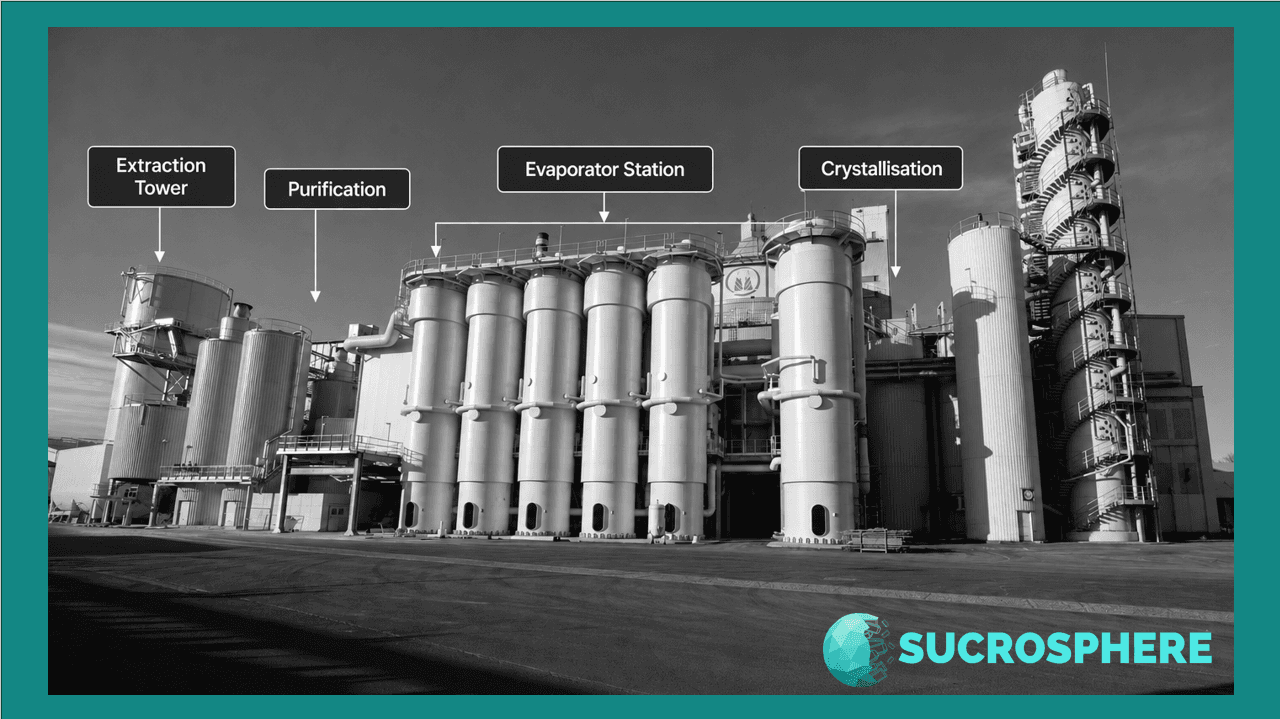
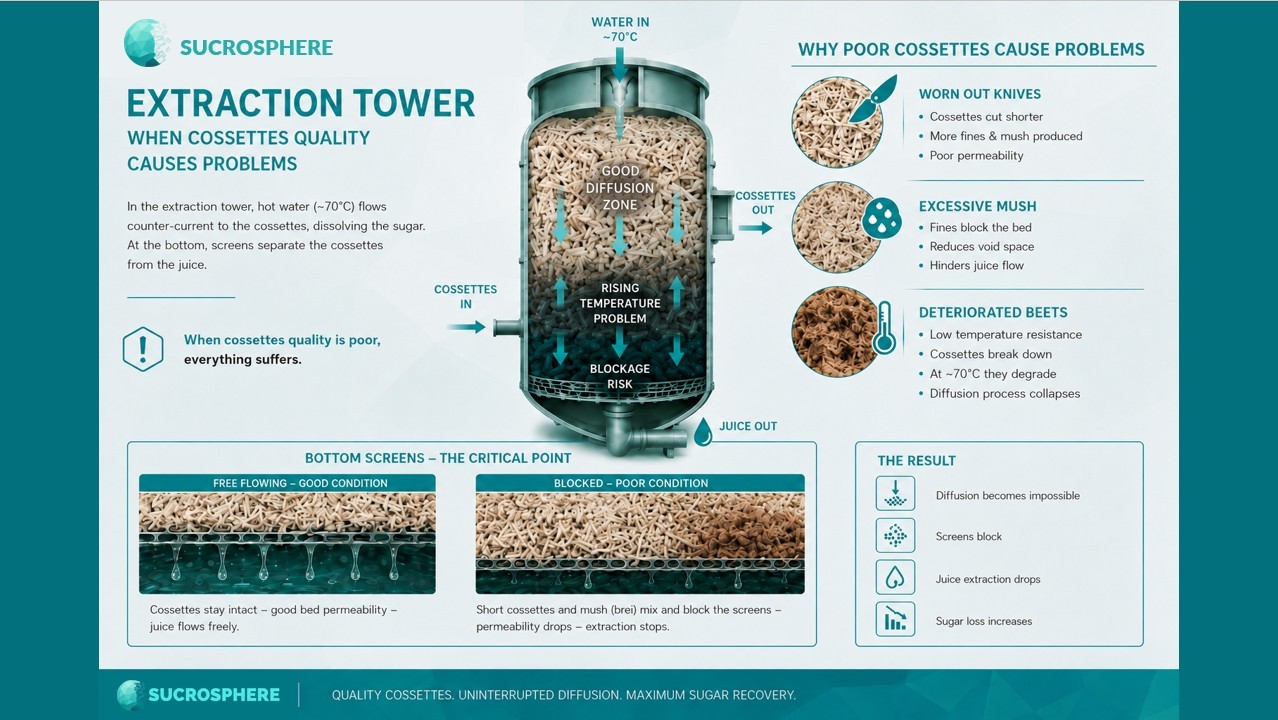
Start where variability is measurable and business impact is clear: extraction, evaporation, crystallisation, centrifugals, or energy balance.
Will AI replace operators?
No. The realistic direction is operator augmentation first and autonomy later. Operators remain essential for supervision, judgment, exception handling, and continuous improvement.
What is the main message for CEOs?
Classic DCS keeps the factory stable. Sucrosphere helps the factory move closer to optimum with measurable impact on energy, yield, quality, and margins.
What is the main message for technical directors?
You do not need a risky automation revolution. You need a controlled path that respects the existing DCS and turns real-time sugar data into better setpoints and more stable operation.
What will decide whether a factory reaches scenario 2 or scenario 3?
Not technology availability alone. The deciding factors are courage, validation discipline, cybersecurity, operator trust, and the speed with which the existing production team adapts.
Want to Learn More?
The deployment methodology and results from our sugar factory projects are in the Sucrosphere white papers.