How Smart Crystal Control combines real-time sensing, model-based control, and self-tuning to make crystallisation transparent, adaptive, and progressively autonomous.
Why Crystallisation Remains the Least Automated Step in the Sugar Factory
Crystallisation is one of the most critical unit operations in sugar production, directly determining product quality, yield, and overall process efficiency. Despite its importance, it remains one of the least transparent and least automated steps in many factories.
In conventional systems, process control is based on measurements such as dry substance (Brix), temperatures, pressures, and fill level. While these parameters allow basic operation, they provide no direct insight into crystal size distribution or supersaturation dynamics. As a result, optimal operation depends largely on manual intervention and heuristic decision-making.
This paper presents Sucrosphere's Smart Crystal Control (SFC Crystallisation): a model-based, sensor-driven solution designed to transform crystallisation into a transparent, adaptive, and self-optimising process.
What Makes Conventional Crystallisation Control Difficult?
In real industrial environments, crystallisation processes rarely operate under stable, ideal conditions. Fluctuations in feed composition, vacuum, steam pressure, and other parameters introduce disturbances that are difficult to manage manually.
The key limitations of conventional control:
- No real-time visibility into crystal size distribution
- Seeding decisions based on operator intuition
- Limited ability to detect and react to process disturbances in time
- Inconsistent product quality and off-spec batches
- Increased energy consumption and reduced yield
These limitations result in costly remelting, inefficient energy usage, and reduced campaign performance.
How Does Smart Crystal Control Work?
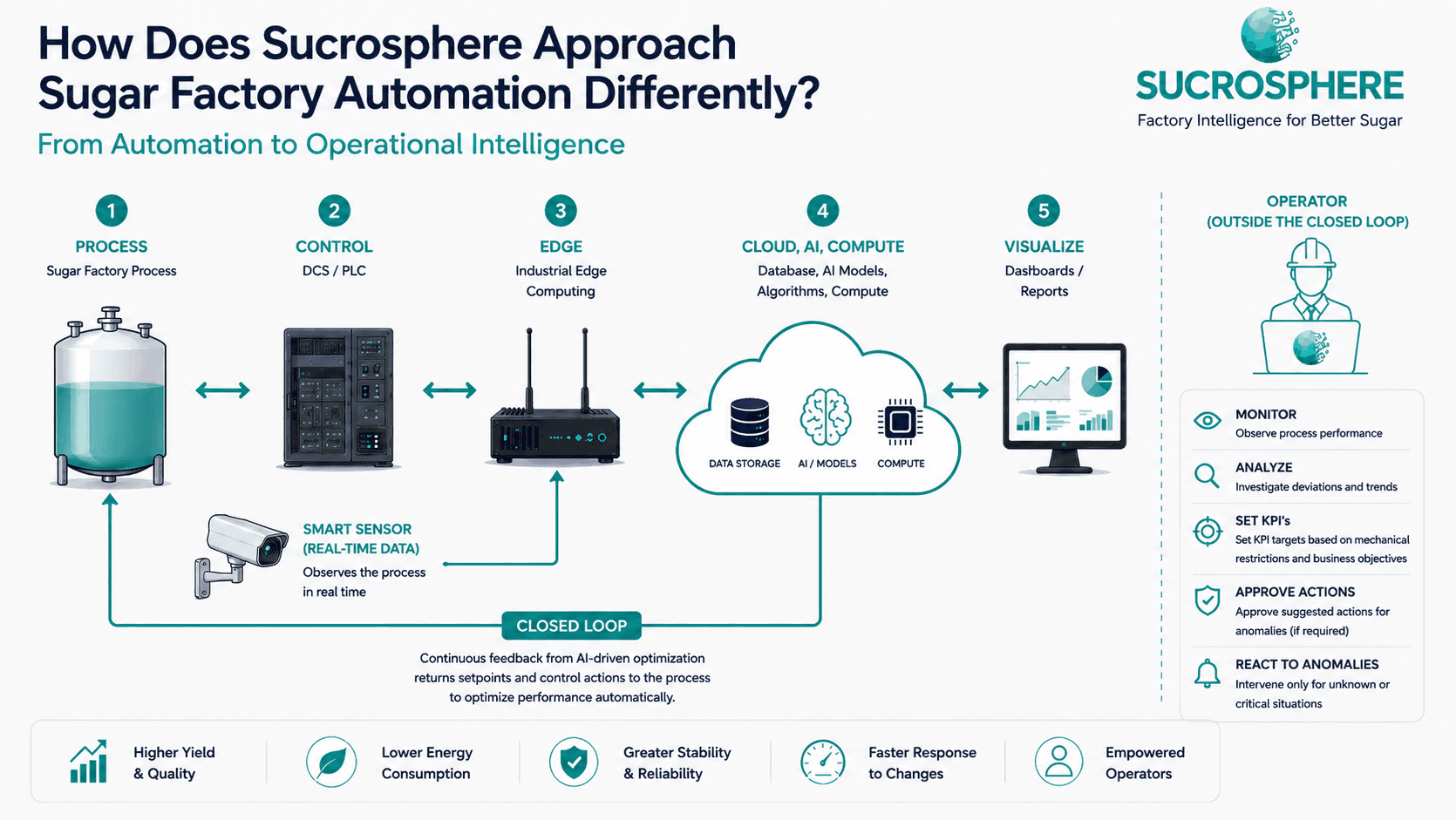
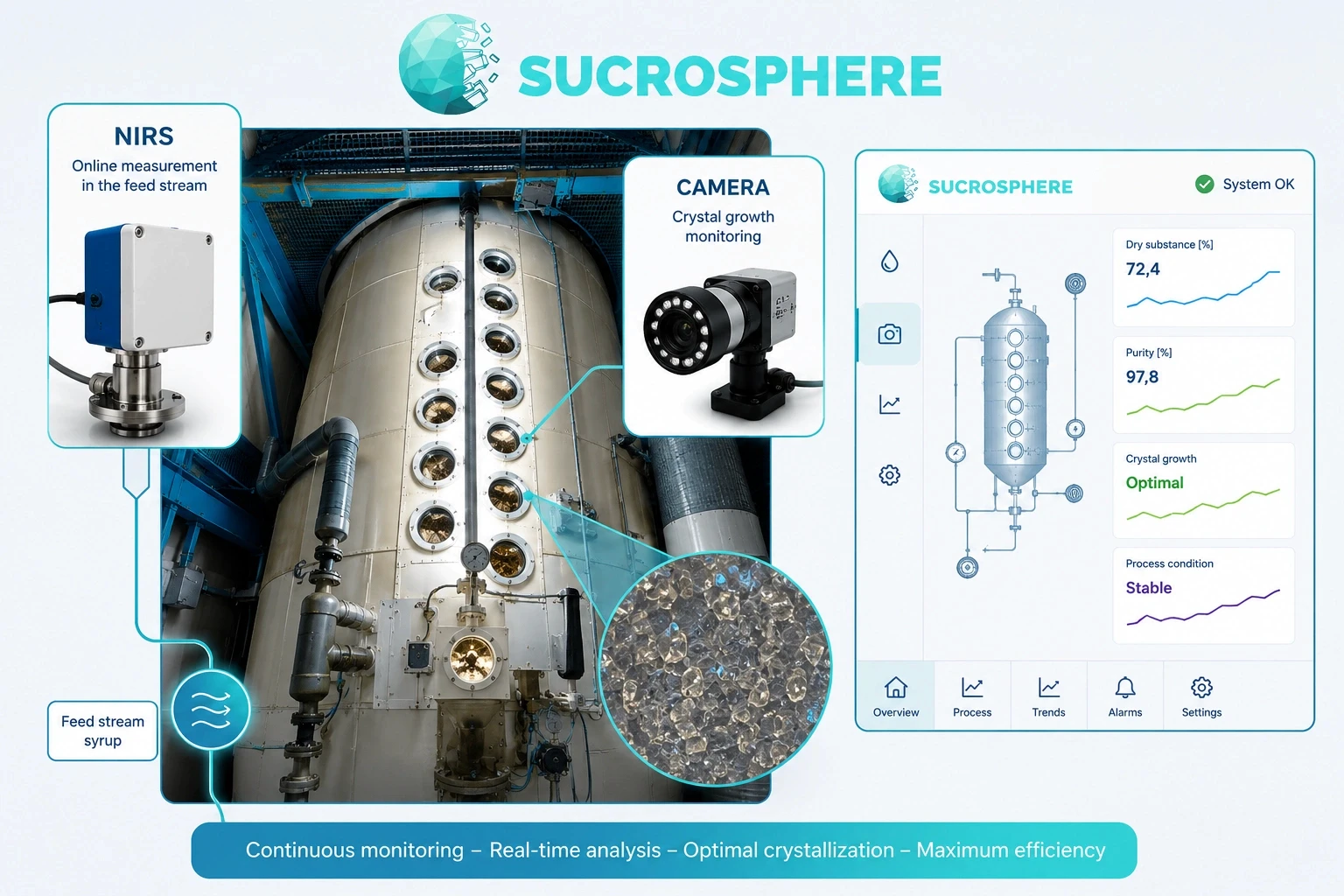
The integrated crystallisation approach replaces manual, experience-based control with continuous, data-driven process optimisation. It integrates multiple sensor technologies with a model-based control algorithm to create a closed-loop system.
The solution consists of 3 core components:
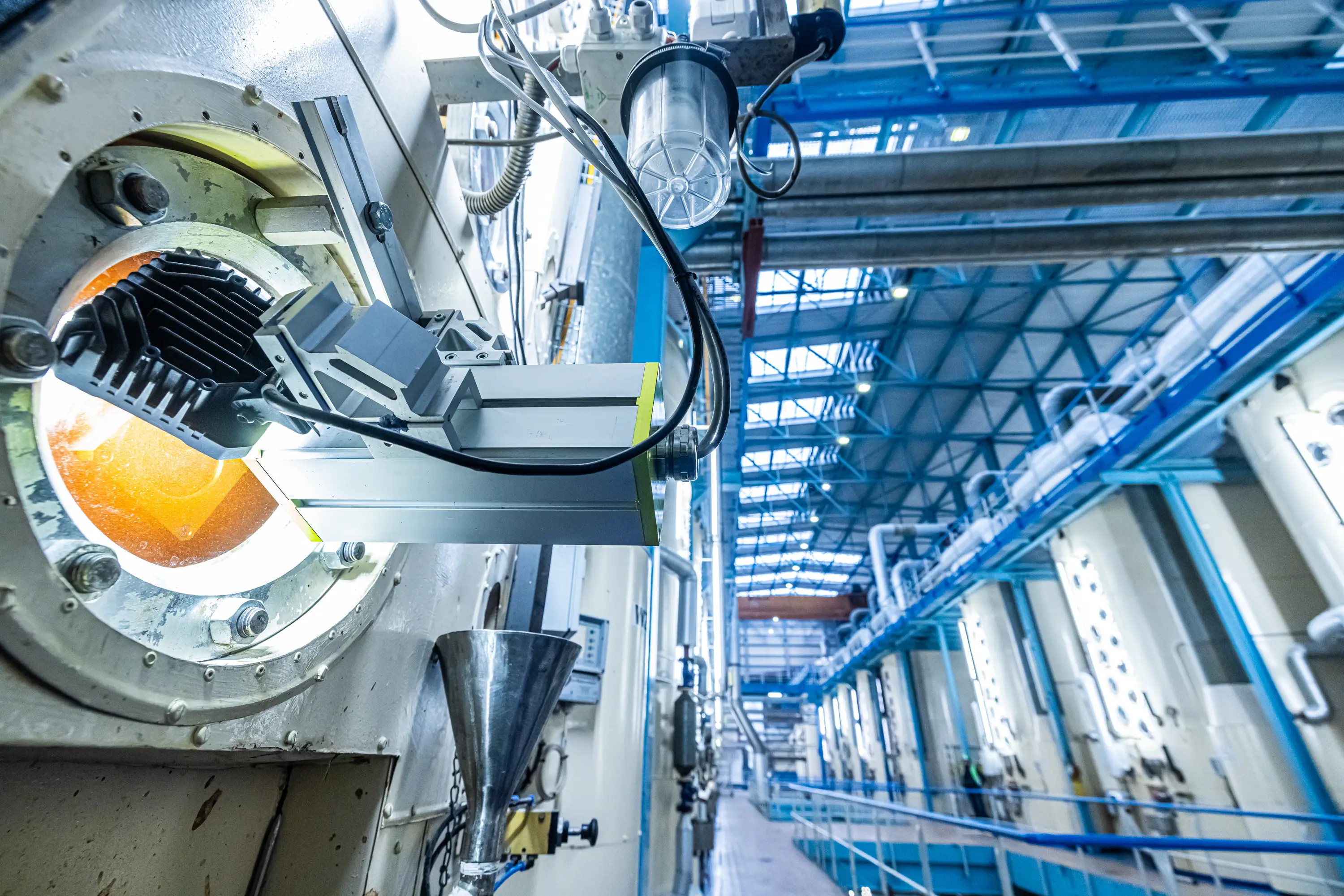
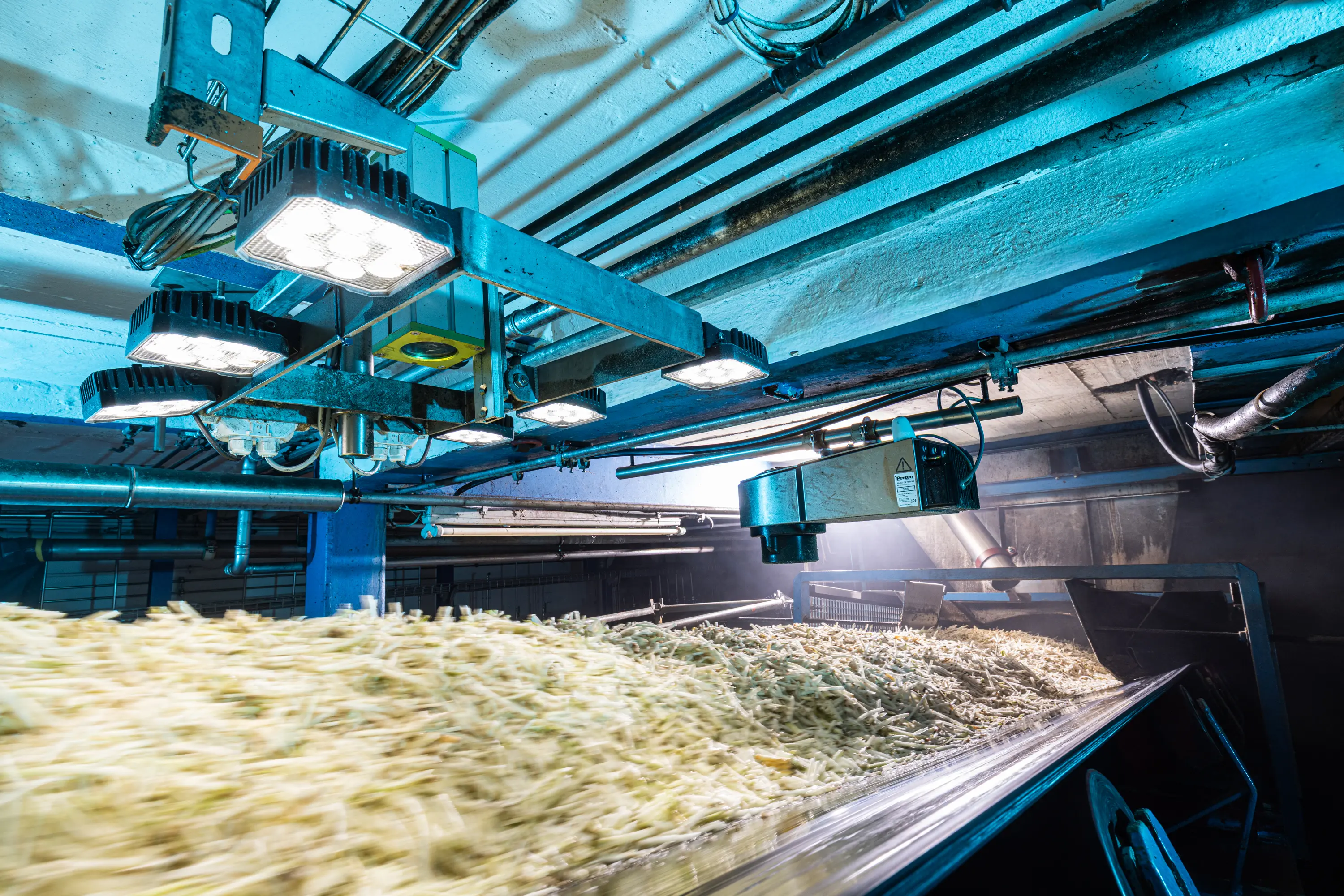
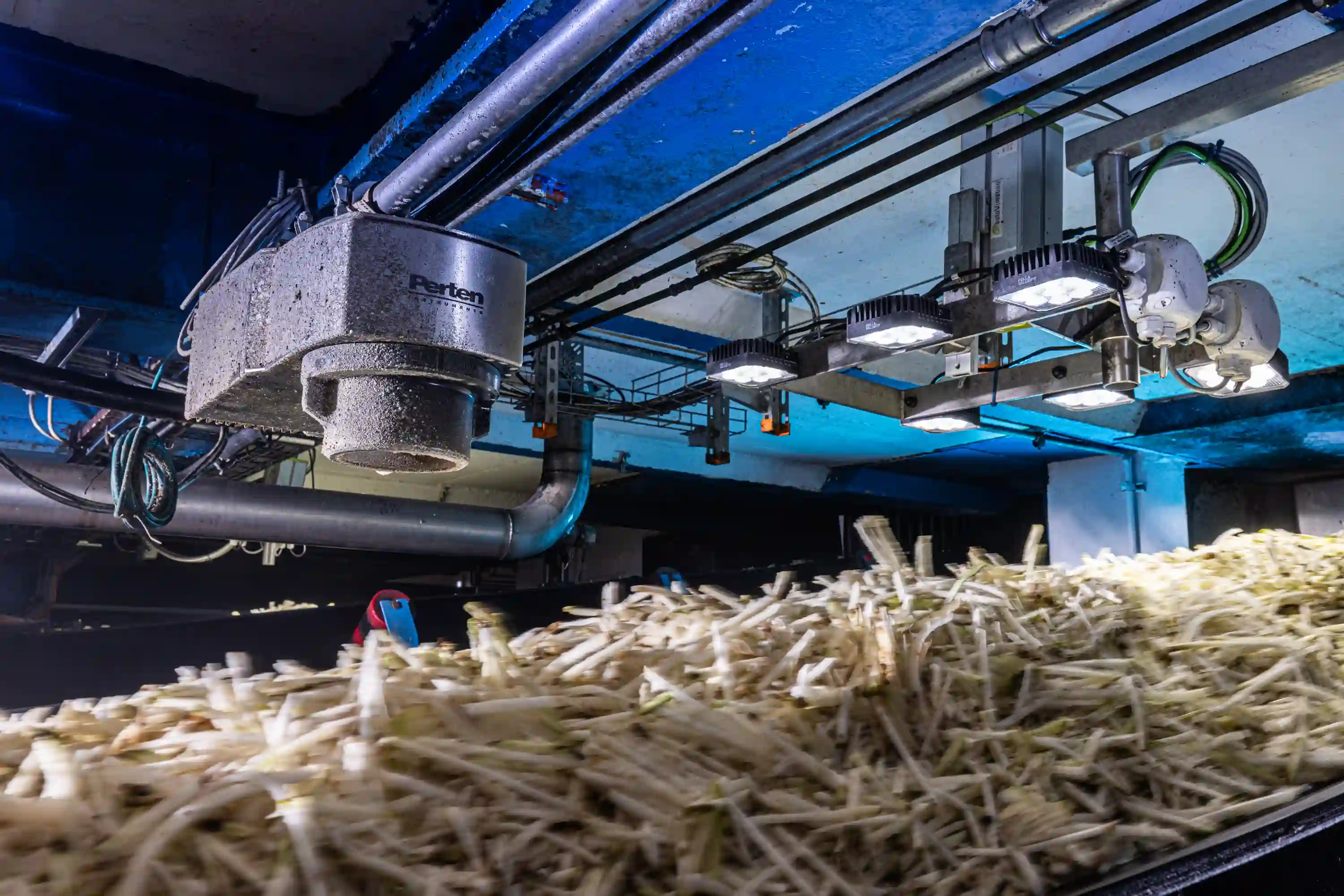
| Visual Smart Sensor (VSS) | Camera-based system monitoring crystal growth in real time. Provides information on crystal size distribution, fines, and massecuite movement. |
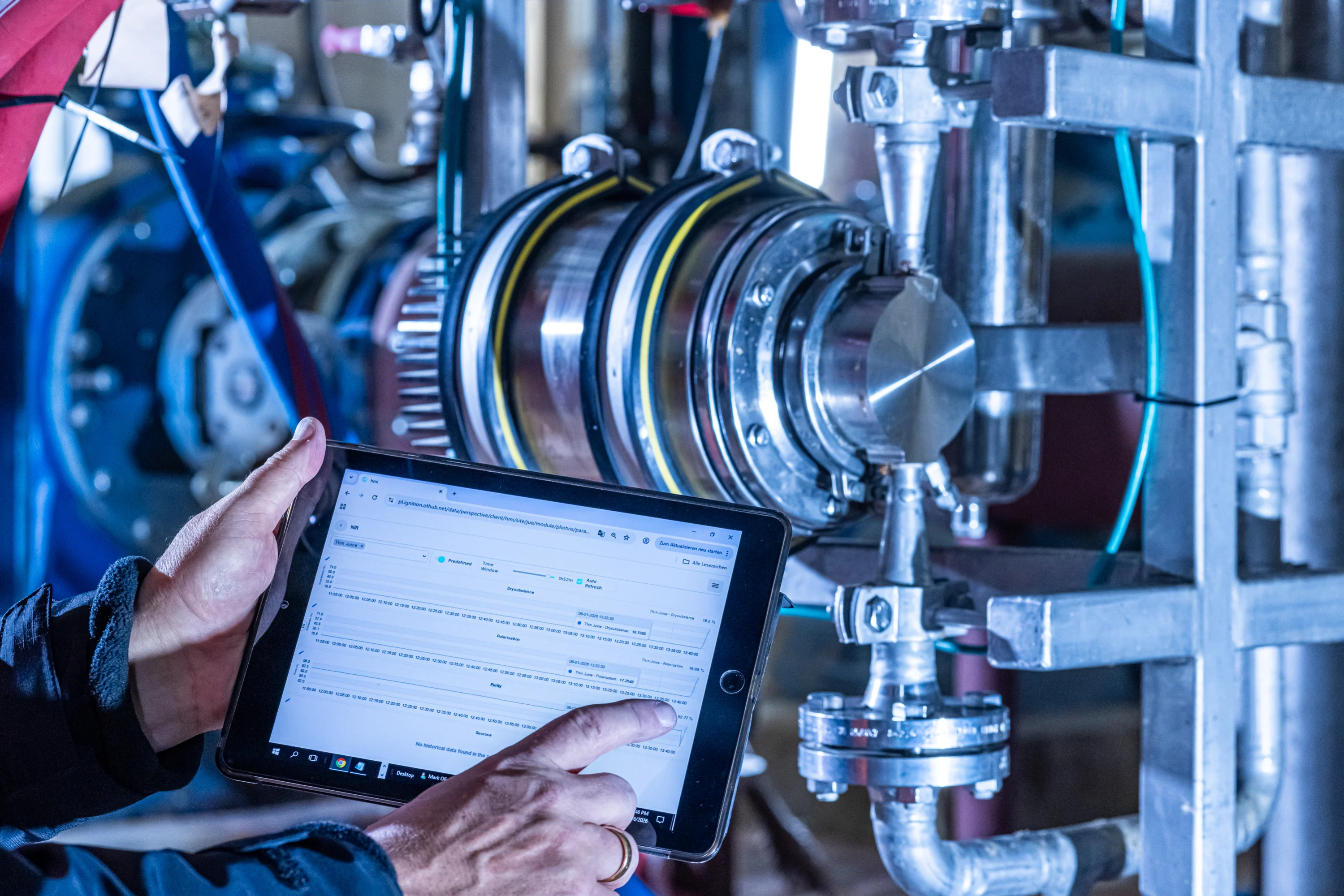
| NIR Spectroscopy | Continuous measurement of feed syrup purity and dry substance. Enables accurate assessment of supersaturation conditions without lab delays. |
| SFC Control Algorithm | Model-based control system integrating all sensor data. Actively controls steam, vacuum, juice, seed, and water based on real-time process state. |
Together, these components create a crystallisation process that is observable, controllable, and progressively autonomous.
How Does the System Determine the Optimal Seeding Strategy?
Seeding is one of the most critical decisions in crystallisation. The SFC system determines the optimal timing of seed addition, the required seed magma quantity, and the target crystal size (d50).
This is achieved by combining 3 data sources:
- Supersaturation derived from NIR and conventional sensors
- Real-time crystal size information from the VSS
- Predefined process KPIs
The result is a precise, reproducible seeding strategy that does not depend on operator intuition or shift-to-shift variability.
How Does the System Detect and Respond to Process Disturbances?
A key capability of Smart Crystal Control is the ability to reliably detect process disturbances and respond in a structured way. In conventional operation, disturbances such as feed composition fluctuations, vacuum instability, or unintended crystal dissolution are typically identified indirectly and require manual intervention.
Within the SFC algorithm, event detection is approached as a context-aware evaluation of multiple data sources simultaneously:
- Conventional process signals (temperature, pressure, Brix)
- Advanced sensor data from NIR and VSS
- Batch-specific process states and historical data
This integrated view enables the identification of deviations not only based on threshold violations, but on process context and expected system behaviour. Detected events are classified according to severity and relevance, forming the basis for selecting appropriate corrective actions:
- Vacuum and steam input adjustments
- Feed rate and boiling curve corrections
- Seeding timing and process trajectory modifications
The system architecture allows these reactions to be evaluated and executed within the current batch or, where more suitable, adapted for subsequent batches.
Current development status: Core mechanisms for event identification and structured evaluation are established. Advanced functionalities for fully autonomous disturbance handling are currently being tested and validated under varying industrial conditions.
How Does the System Improve Over Time?
Beyond real-time monitoring and adaptive response, a central objective of the SFC approach is the continuous improvement of process performance across successive batches. In conventional crystallisation, parameter adjustments are based on operator experience and retrospective evaluation, which leads to inconsistent results and slow optimisation cycles.
The SFC algorithm introduces a data-driven self-tuning mechanism that systematically refines process parameters based on observed outcomes. After each batch, the system evaluates:
- Achieved crystal size (d50)
- Process stability and occurrence of disturbances
- Energy consumption and batch duration
These results are correlated with the applied control strategies and process conditions, enabling the identification of parameter sets that contribute to improved performance. Based on this evaluation, the system implements incremental parameter adjustments for subsequent batches.
This conservative principle ensures that process stability is maintained while gradually converging toward optimal operating conditions. Adjustments are continuously assessed: if a modification does not yield the expected improvement, it is reversed or refined. This creates a controlled learning loop that avoids persistent degradation from suboptimal parameter changes.
Current development status: The framework for performance evaluation and parameter adjustment is defined, and a systematic optimisation strategy is in test operation. Fully autonomous self-tuning with closed-loop learning across batches is subject to ongoing testing and industrial validation.
How Does Smart Crystal Control Integrate Into Existing Factories?
Smart Crystal Control is designed for integration into existing plant infrastructure without disrupting operations.
Key integration features:
- Standardised supervision logic compatible with PLC systems
- Communication via MQTT and OPC UA
- Runs alongside existing control systems
This architecture allows gradual adoption from a single crystalliser to full factory deployment, in phases, without replacing existing DCS or PLC logic.
What Does Smart Crystal Control Deliver?
Smart Crystal Control represents a significant step toward the digitalisation of sugar production. By combining real-time sensing, model-based control, and self-learning capabilities, it transforms crystallisation from an operator-driven process into an increasingly autonomous, optimised system.
Key outcomes:
- Increased transparency of the crystallisation process
- Reduction of operator dependency
- Improved product quality and consistency
- Enhanced energy efficiency and yield
This approach lays the foundation for fully automated sugar factories, where critical processes operate with minimal human intervention while achieving consistently optimal performance.
What Comes Next?
Future development will focus on:
- Scaling the system across entire factories
- Refining event detection, reaction, and self-tuning capabilities
- Integrating with broader plant optimisation platforms
Sucrosphere's objective is a fully connected, self-optimising sugar production ecosystem.
Want to Learn More?
The deployment methodology and results from our crystallisation projects are in the Sucrosphere white papers.
Or get in touch to discuss what Smart Crystal Control could look like at your factory.
Frequently Asked Questions
What is Smart Crystal Control (SFC Crystallisation)?
Smart Crystal Control is Sucrosphere's integrated crystallisation solution that combines real-time sensor technologies, advanced process models, and adaptive control algorithms to optimise batch sugar crystallisation. It transforms crystallisation from an operator-dependent process into a transparent, data-driven operation.
How does Smart Crystal Control improve sugar crystallisation?
The system continuously monitors crystal growth, syrup quality, and process conditions. Based on this information, it automatically optimises seeding, feed rates, steam input, vacuum conditions, and other process parameters to improve crystal quality, yield, and process stability.
Which sensors are used in the Smart Crystal Control system?
The solution integrates a Visual Smart Sensor (VSS) for real-time crystal observation and Near-Infrared Spectroscopy (NIR) for continuous measurement of syrup properties. These are combined with conventional process measurements such as temperature, pressure, Brix, and vessel level.
Can Smart Crystal Control detect process disturbances automatically?
Yes. The system continuously evaluates process data and sensor information to identify disturbances such as feed composition changes, vacuum instability, or unexpected crystal behaviour. It can then recommend or execute corrective actions based on predefined control strategies.
How does the system optimise seeding?
Smart Crystal Control determines the optimal timing and quantity of seed addition by combining real-time crystal size information, supersaturation calculations, and process objectives. This ensures consistent crystal development and reduces reliance on operator experience.
Does Smart Crystal Control support self-learning and continuous improvement?
The system includes a self-tuning framework that evaluates the performance of each batch and identifies opportunities for optimisation. Based on these results, control parameters can be refined over time to improve consistency, energy efficiency, and overall process performance.
Can Smart Crystal Control be integrated into existing sugar factories?
Yes. The solution is designed for integration into existing plant infrastructures. It supports standard industrial communication protocols such as OPC UA and MQTT and can operate alongside existing PLC and automation systems.
What are the main benefits of Smart Crystal Control?
Key benefits include improved product quality, reduced operator dependency, higher process transparency, increased energy efficiency, better yield performance, and a foundation for autonomous sugar factory operation.
Is Smart Crystal Control suitable for both beet and cane sugar factories?
Yes. The underlying control philosophy is applicable to both beet and cane sugar production, provided the necessary process data and sensor infrastructure are available.
How does Smart Crystal Control contribute to factory digitalisation?
By combining advanced sensing, process modelling, adaptive control, and continuous optimisation, Smart Crystal Control creates a digital representation of the crystallisation process and supports the transition toward fully connected and self-optimising sugar factories.