COMMERCIAL MODEL / PLATFORM

Beyond the Sensor: Why a Connected Platform Changes What a Measurement Is Worth

Beyond the Sensor: Why a Connected Platform Changes What a Measurement Is Worth

Beyond the Sensor: Why a Connected Platform Changes What a Measurement Is Worth

Beyond the Sensor: Why a Connected Platform Changes What a Measurement Is Worth

Website developed by Piotr Tyrakowski

The first post covered the commercial case for renting sensors. This one covers what makes the platform behind them fundamentally different from a device you buy and forget.

This is part 2 of a 2-part series on Device as a Service. Part 1 covered the commercial model: what DaaS is, why sensors get stuck in CAPEX, and when renting makes more sense than buying.

The commercial case for Device as a Service is about removing a procurement barrier. But the deeper case is about what happens after the sensor is installed. Connected devices on the Sucrosphere platform receive continuous software and model updates, contribute to a shared data foundation, and improve in analytical capability over time. The customer is not buying hardware. They are accessing an evolving optimisation capability.

The previous post covered the commercial mechanics of Device as a Service: how it changes the starting point of instrumentation projects, what it costs, and when buying outright still makes more sense. That argument is largely about procurement, and it is an important one.

But there is a second argument that goes further, and it has nothing to do with CAPEX versus OPEX. It is about what the measurement itself becomes when the device is part of a connected platform rather than a standalone piece of hardware.

The Problem With Traditional Industrial Instrumentation

Traditional industrial instrumentation is usually installed with a defined set of functions. New features, revised algorithms, or improved models often require a manual software update, local access to the device, or even a service visit with a laptop. That approach was acceptable when product development cycles were measured in years.

Software-driven optimisation is different. New algorithms, improved prediction models, and better analytics can be developed much faster than hardware can be replaced. A sensor installed today with the best available models may be running on outdated analytical logic within two or three years, even if the hardware is physically identical.

The question this raises is not whether the device still works. It is whether it is still delivering the best possible insight.

Continuous Updates Without the Maintenance Burden

Sucrosphere devices are updated the way modern software platforms update: when improved models, new features, or better analytics are available, they are deployed through the platform without requiring the customer to organise individual updates for every device.

The practical effect is significant. The customer does not have to track software versions, organise update campaigns, or decide when a new model should be installed. These activities become part of the service. A device installed during this campaign has access to improvements developed during the following year, without any action required from the plant.

With a conventional device, technological ageing starts immediately after purchase. In a service-based platform model, the objective is different: keep the installed device technologically relevant by continuously improving the software, models, and analytics around it.

This changes the lifecycle economics significantly. A conventional instrument purchased today is unlikely to benefit from the analytical improvements made next year. A connected device on the Sucrosphere platform is designed to.

The Platform Effect: Better Data Creates Better Models

There is an additional benefit that becomes possible only when devices are connected through a common platform, and it is one of the strongest arguments for a service model over standalone hardware.

Each individual installation creates process data. Across multiple installations, that data can help improve the understanding of process behaviour, operating conditions, and measurement performance. When this information is used in a controlled, secure, and appropriately anonymised way, it can support the continuous development of better analytical and predictive models.

This creates what is sometimes called a platform effect: more operating experience leads to better models, and better models lead to more accurate predictions. That is fundamentally different from a standalone sensor.

A traditional device mainly learns from its own calibration and its own operating history. A connected platform can potentially benefit from a much broader set of operating situations, process disturbances, and rare events. The hardest situations to model are often the ones that occur infrequently. A single factory may experience a particular disturbance only once every few campaigns. Across a broader installed base, similar events may occur much more often, and the model learns from all of them.

The long-term value of the platform is not only that more devices can be connected. It is that the quality of the prediction itself can improve over time.

What the Customer Is Actually Buying

This is the distinction that matters most. A factory purchasing a conventional sensor is buying a piece of hardware with a fixed analytical capability. That capability may be excellent on the day of installation, but it is unlikely to be better two years later.

A factory using the Sucrosphere platform is accessing something different: an evolving measurement and optimisation capability. The hardware is the entry point. The value compounds over time through software improvements, model updates, and the shared learning that comes from operating across multiple factories and campaigns.

The customer is not simply paying for access to hardware. They are participating in an ecosystem in which sensing, software, models, and operational knowledge evolve together.

Sensors create data. Data enables models. Models make future process behaviour predictable. And predictive information allows advanced control systems to continuously optimise the process. The sensor is therefore the beginning of the optimisation chain, not the end product. How that sensor is maintained, updated, and connected to a broader learning system determines how much of that chain actually delivers value.

Want to Know More?

The deployment methodology and results from our sensor and optimisation projects are in the Sucrosphere white papers.
About the author

Dr. Arend Wittenberg

Management team at Pfeifer & Langen IP GmbH / Sucrosphere. Arend brings more than 30 years of experience in the international sugar industry, including senior leadership at Cosun and Nordzucker and most recently as Managing Director of the BMA Group. At Sucrosphere, he focuses on international business development, customer relationships, and strategic partnerships. sucrosphere.com/about

READ MORE ARTICLES

READ MORE ARTICLES

COMMERCIAL MODEL / PLATFORM

Beyond the Sensor: Why a Connected Platform Changes What a Measurement Is Worth

The first post covered the commercial case for renting sensors. This one covers what makes the platform behind them fundamentally different from a device you buy and forget.

COMMERCIAL MODEL / PLATFORM

Beyond the Sensor: Why a Connected Platform Changes What a Measurement Is Worth

The first post covered the commercial case for renting sensors. This one covers what makes the platform behind them fundamentally different from a device you buy and forget.

COMMERCIAL MODEL / INSTRUMENTATION

Device as a Service: How Renting Sensors Changes the Business Case for Optimisation

Why instrumentation keeps getting stuck in capital budgets, and how a different commercial model changes who has to approve it and how long that takes.

COMMERCIAL MODEL / INSTRUMENTATION

Device as a Service: How Renting Sensors Changes the Business Case for Optimisation

Why instrumentation keeps getting stuck in capital budgets, and how a different commercial model changes who has to approve it and how long that takes.

PLATFORM / AUTOMATION

What Is Sucrosphere's Factory Coordination Layer, and Why Does It Matter?

A well-tuned MPC on every stage and the factory can still run below what it is capable of. Here is why, and what the coordination layer above the MPCs actually does.

PLATFORM / AUTOMATION

What Is Sucrosphere's Factory Coordination Layer, and Why Does It Matter?

A well-tuned MPC on every stage and the factory can still run below what it is capable of. Here is why, and what the coordination layer above the MPCs actually does.

EVENTS / INDIA

Sucrosphere at STAI 2026 Goa: From Digitalisation to Autonomous Sugar Factory Operations

Mark O. Burkhardt and Wolfgang Klosterhalfen will present at the STAI Conference in Goa, India, 18 to 20 August 2026.

EVENTS / INDIA

Sucrosphere at STAI 2026 Goa: From Digitalisation to Autonomous Sugar Factory Operations

Mark O. Burkhardt and Wolfgang Klosterhalfen will present at the STAI Conference in Goa, India, 18 to 20 August 2026.

AUTOMATION / PROCESS CONTROL

From Reactive to Predictive: How the Sugar Industry Is Moving Beyond PID Control

The tool that got sugar factories here is not the tool that takes them further. Here is what changed, why it took this long, and what the shift to MPC actually looks like.

AUTOMATION / PROCESS CONTROL

From Reactive to Predictive: How the Sugar Industry Is Moving Beyond PID Control

The tool that got sugar factories here is not the tool that takes them further. Here is what changed, why it took this long, and what the shift to MPC actually looks like.

NEWS / TEAM

Dr. Arend Wittenberg Joins the Management Team of Pfeifer & Langen IP GmbH

30+ years in the international sugar industry. Former Managing Director of BMA Group. Now focused on building Sucrosphere's global reach.

NEWS / TEAM

Dr. Arend Wittenberg Joins the Management Team of Pfeifer & Langen IP GmbH

30+ years in the international sugar industry. Former Managing Director of BMA Group. Now focused on building Sucrosphere's global reach.

SERIES: SUGAR FACTORY AUTOMATION 2026 / PART 3

The Autonomous Sugar Factory: Scenarios for the Next 5 Years

By 2031, sugar factories will face 3 realistic scenarios: conservative DCS evolution, AI-assisted operations as standard...

SERIES: SUGAR FACTORY AUTOMATION 2026 / PART 3

The Autonomous Sugar Factory: Scenarios for the Next 5 Years

By 2031, sugar factories will face 3 realistic scenarios: conservative DCS evolution, AI-assisted operations as standard...

SERIES: SUGAR FACTORY AUTOMATION 2026 / PART 2

From Automation to Optimisation: MPC, Sensors, and Real Campaign Value

Part 1 showed why classic DCS stability is no longer enough. Part 2 goes deeper: which technologies are proven in real...

SERIES: SUGAR FACTORY AUTOMATION 2026 / PART 2

From Automation to Optimisation: MPC, Sensors, and Real Campaign Value

Part 1 showed why classic DCS stability is no longer enough. Part 2 goes deeper: which technologies are proven in real...

SERIES: SUGAR FACTORY AUTOMATION 2026 /PART 1

Where Sugar Factory Automation Stands in 2026

Where the industry stands, where it is going, and why Sucrosphere becomes the sugar-specific optimisation layer.

SERIES: SUGAR FACTORY AUTOMATION 2026 /PART 1

Where Sugar Factory Automation Stands in 2026

Where the industry stands, where it is going, and why Sucrosphere becomes the sugar-specific optimisation layer.

CRYSTALLISATION

A Data-Driven Approach to Optimising Batch Sugar Crystallisation

How Smart Crystal Control combines real-time sensing, model-based control, and self-tuning to make crystallisation transparent, adaptive, and progressively autonomous.

CRYSTALLISATION

A Data-Driven Approach to Optimising Batch Sugar Crystallisation

How Smart Crystal Control combines real-time sensing, model-based control, and self-tuning to make crystallisation transparent, adaptive, and progressively autonomous.

INFORMATION

When the Tower Won't Listen: Automated Pressure Protection for Beet Extraction

An MPC-integrated pressure protection logic that absorbs beet extraction tower overpressure automatically, cutting...

INFORMATION

When the Tower Won't Listen: Automated Pressure Protection for Beet Extraction

An MPC-integrated pressure protection logic that absorbs beet extraction tower overpressure automatically, cutting...

PHILOSOPHY

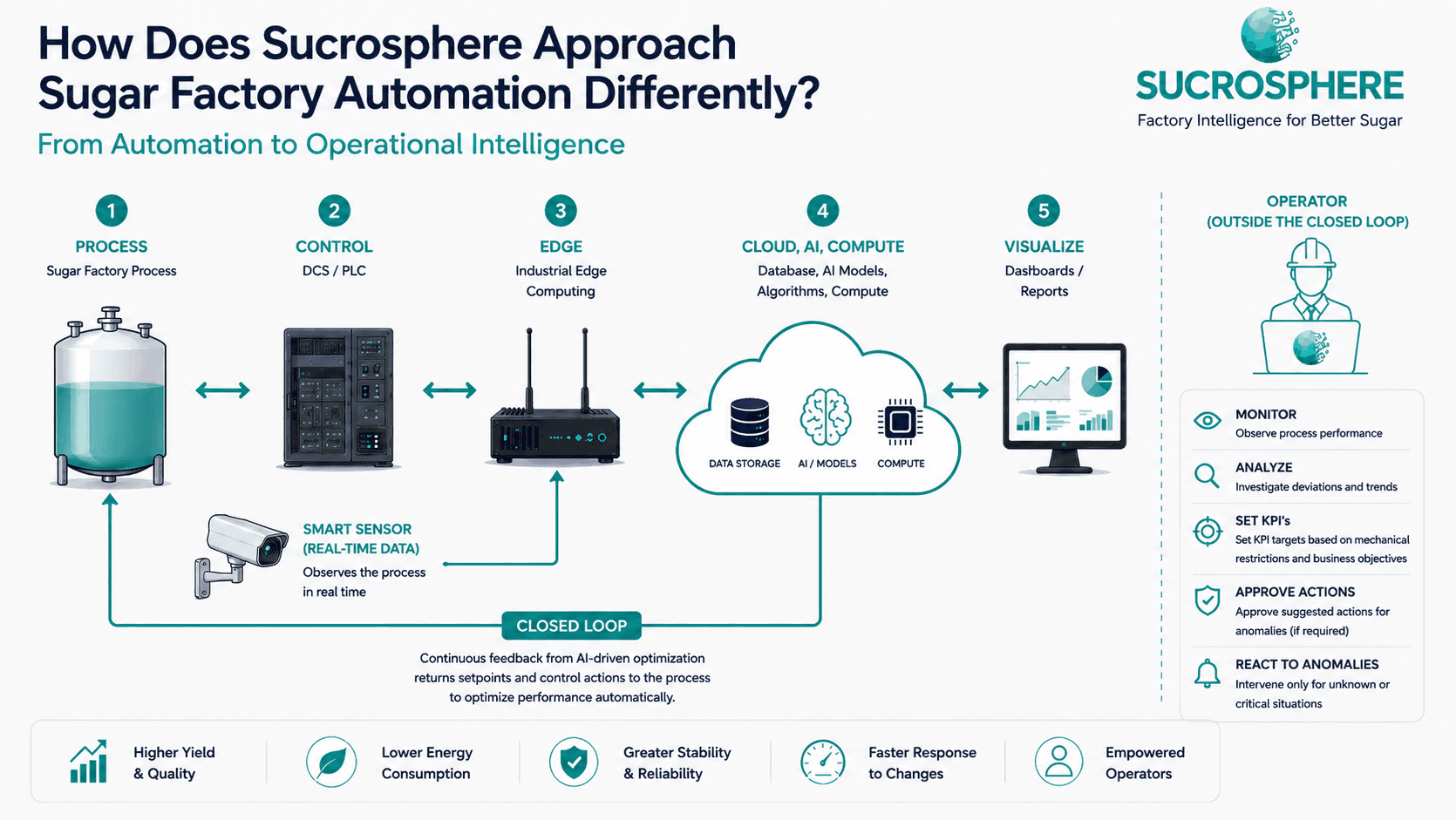
How Does Sucrosphere Approach Sugar Factory Automation Differently?

Sucrosphere approaches sugar factory automation as a connected factory intelligence platform rather than a collection of point solutions. Built on 150 years of Pfeifer & Langen...

PHILOSOPHY

How Does Sucrosphere Approach Sugar Factory Automation Differently?

Sucrosphere approaches sugar factory automation as a connected factory intelligence platform rather than a collection of point solutions. Built on 150 years of Pfeifer & Langen...

CONFERENCE

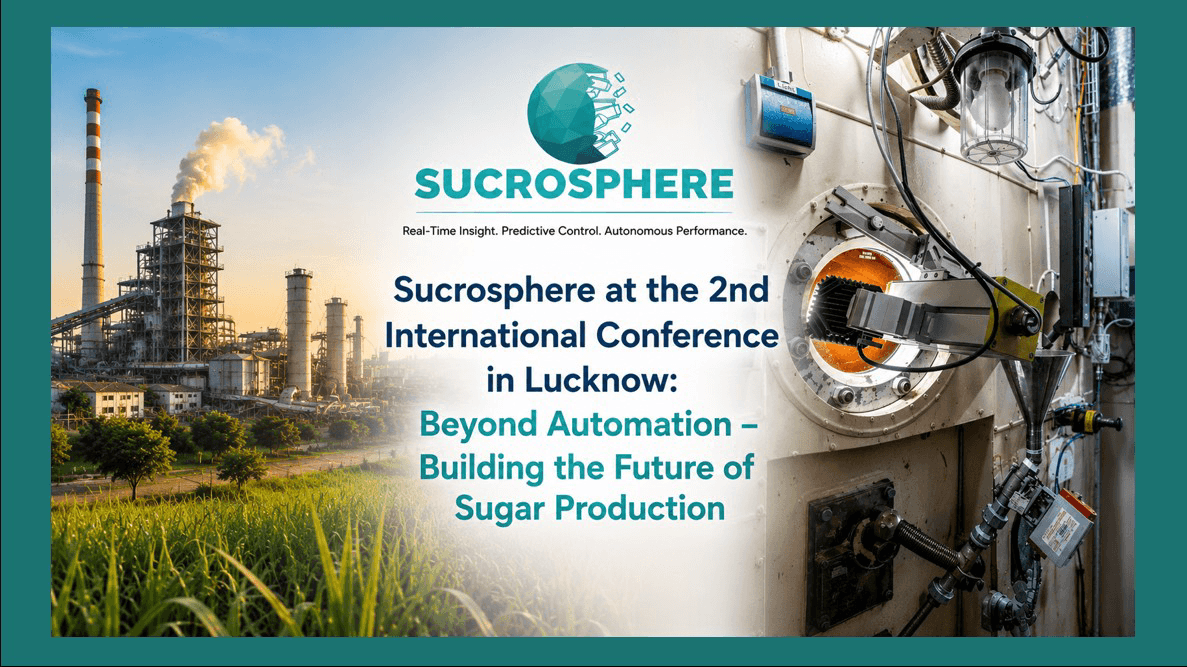
Sucrosphere at UPSMA 2026: 3 Steps from Automation to Autonomous Operation

Sucrosphere is presenting at the UPSMA 2nd International Conference on Future Ready Sugar Industry in Lucknow, India...

CONFERENCE

Sucrosphere at UPSMA 2026: 3 Steps from Automation to Autonomous Operation

Sucrosphere is presenting at the UPSMA 2nd International Conference on Future Ready Sugar Industry in Lucknow, India...

CONFERENCE

Sucrosphere at VDZ/ESST 2026: MPC, Smart Crystal Control, and the Autonomous Sugar Factory

On Day 1 of the 9th VDZ/ESST Conference in Lubeck, Sucrosphere presented live results from 2 deployed systems: MPC-based...

CONFERENCE

Sucrosphere at VDZ/ESST 2026: MPC, Smart Crystal Control, and the Autonomous Sugar Factory

On Day 1 of the 9th VDZ/ESST Conference in Lubeck, Sucrosphere presented live results from 2 deployed systems: MPC-based...

AUTOMATION

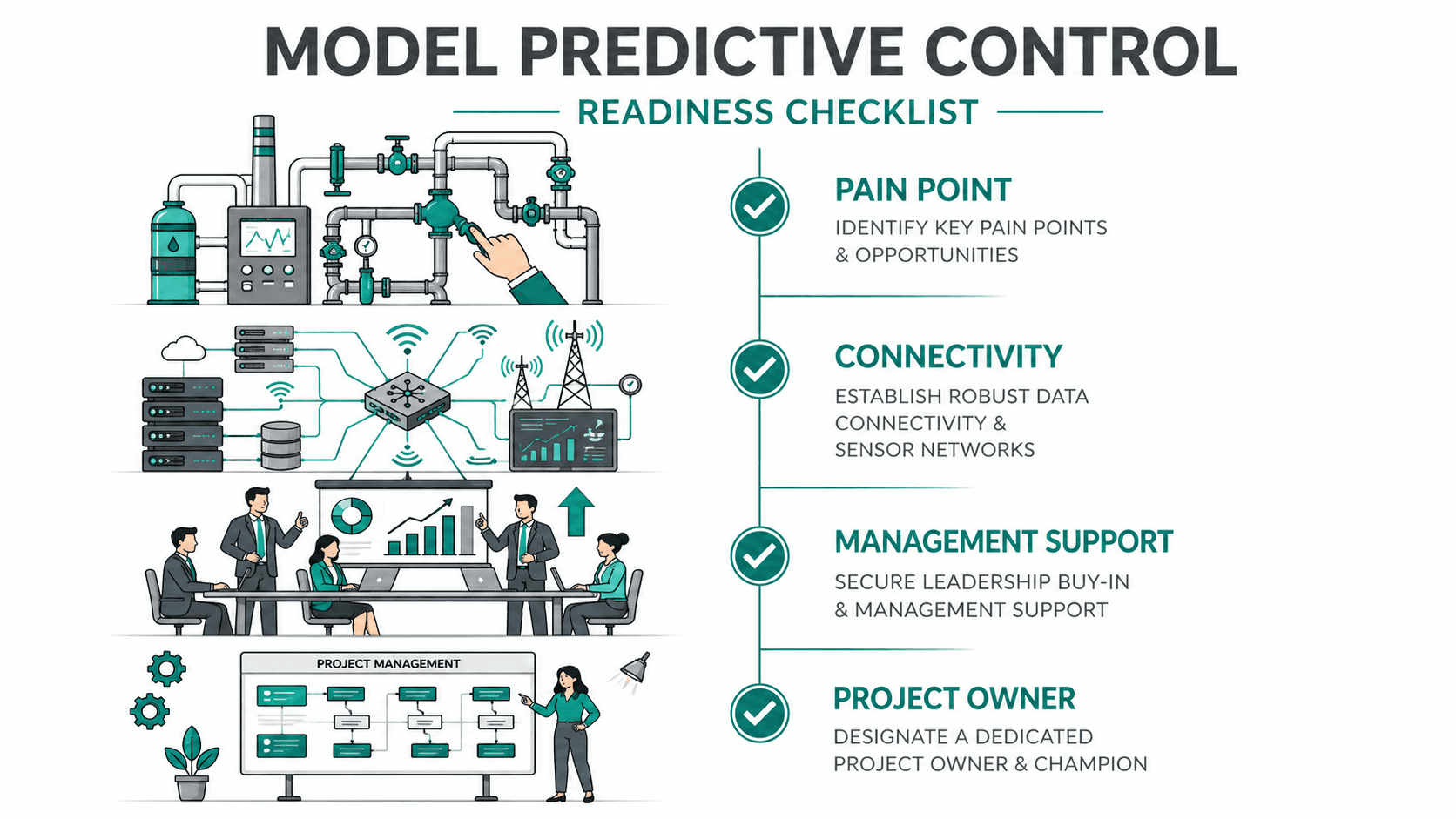
Sugar Factory Automation Checklist: 10 Signs You Are Ready to Implement MPC

A sugar factory is ready to implement Model Predictive Control (MPC) when it has OPC-UA connectivity, a process engineer who understands...

AUTOMATION

Sugar Factory Automation Checklist: 10 Signs You Are Ready to Implement MPC

A sugar factory is ready to implement Model Predictive Control (MPC) when it has OPC-UA connectivity, a process engineer who understands...

EXTRACTION OPTIMIZATION

Smart Extraction Control: How VSS, NIRS, and MPC Are Redefining Sugar Recovery

Smart Extraction Control combines a Visual Smart Sensor (VSS) for cossette quality, NIRS sensors across all extraction streams, and...

EXTRACTION OPTIMIZATION

Smart Extraction Control: How VSS, NIRS, and MPC Are Redefining Sugar Recovery

Smart Extraction Control combines a Visual Smart Sensor (VSS) for cossette quality, NIRS sensors across all extraction streams, and...

EVENT RECAP

Smart Crystal Control

Smart Crystal Control is an integrated system that uses a Visual Sensor System (VSS) and NIR spectroscopy to measure crystal population and feed syrup quality in real time, and a model-based...

EVENT RECAP

Smart Crystal Control

Smart Crystal Control is an integrated system that uses a Visual Sensor System (VSS) and NIR spectroscopy to measure crystal population and feed syrup quality in real time, and a model-based...

INFORMATION

What Is Model Predictive Control (MPC) in Sugar Production?

MPC is a software layer that uses a mathematical model of your process to calculate the optimal control actions for the next hour, not just the next setpoint. It manages...

INFORMATION

What Is Model Predictive Control (MPC) in Sugar Production?

MPC is a software layer that uses a mathematical model of your process to calculate the optimal control actions for the next hour, not just the next setpoint. It manages...

OPTIMIZATION

NIR Spectroscopy in Sugar Processing - Real-Time Sugar Monitoring

NIRS has evolved from a laboratory technique into a core enabler of real-time process control in modern sugar production.

OPTIMIZATION

NIR Spectroscopy in Sugar Processing - Real-Time Sugar Monitoring

NIRS has evolved from a laboratory technique into a core enabler of real-time process control in modern sugar production.

COST REDUCTION

5 Hidden Costs Killing Sugar Production Profits (How to Fix)

Discover five hidden costs draining sugar production profits and proven solutions to reduce expenses by €400K per campaign using automation

COST REDUCTION

5 Hidden Costs Killing Sugar Production Profits (How to Fix)

Discover five hidden costs draining sugar production profits and proven solutions to reduce expenses by €400K per campaign using automation

OPTIMIZATION

How to Increase Sugar Yield: Complete 2026 Optimization Guide

Increase sugar extraction yield by 0.6% using proven process optimization techniques. Learn about NIRS, MPC systems, and IoT integration for sugar plants.

OPTIMIZATION

How to Increase Sugar Yield: Complete 2026 Optimization Guide

Increase sugar extraction yield by 0.6% using proven process optimization techniques. Learn about NIRS, MPC systems, and IoT integration for sugar plants.

NEWS

From Strategy to Shopfloor: How AI Is Delivering Real Value in Sugar Production

Key takeaways from SUCROSPHERE'S AI Roadmap Workshop at the 26th CSI Conference in Marrakesh

NEWS

From Strategy to Shopfloor: How AI Is Delivering Real Value in Sugar Production

Key takeaways from SUCROSPHERE'S AI Roadmap Workshop at the 26th CSI Conference in Marrakesh

INFORMATION

Sucrosphere Extraction Solutions

Boost extraction yield and cut costs. See how our Digital Extraction Package uses MPC and real-time sensors to unlock up to 0.4 €/t in savings.

INFORMATION

Sucrosphere Extraction Solutions

Boost extraction yield and cut costs. See how our Digital Extraction Package uses MPC and real-time sensors to unlock up to 0.4 €/t in savings.

NEWS

MPC deployments: lessons from the last season

From digital twins to verified ROI: we share three critical lessons learned from our recent real-world MPC deployments in sugar factories.

NEWS

MPC deployments: lessons from the last season

From digital twins to verified ROI: we share three critical lessons learned from our recent real-world MPC deployments in sugar factories.

INFORMATION

Carbonatation control that lowers energy use

Stabilize raw juice quality and cut energy costs. Learn how advanced NIR sensors optimize purification today and pave the way for full automation.

INFORMATION

Carbonatation control that lowers energy use

Stabilize raw juice quality and cut energy costs. Learn how advanced NIR sensors optimize purification today and pave the way for full automation.