PLATFORM / AUTOMATION

What Is Sucrosphere's Factory Coordination Layer, and Why Does It Matter?

What Is Sucrosphere's Factory Coordination Layer, and Why Does It Matter?

What Is Sucrosphere's Factory Coordination Layer, and Why Does It Matter?

What Is Sucrosphere's Factory Coordination Layer, and Why Does It Matter?

Website developed by Piotr Tyrakowski

A well-tuned MPC on every stage and the factory can still run below what it is capable of. Here is why, and what the coordination layer above the MPCs actually does.

The factory coordination layer is a control layer above the individual process MPCs. It takes production targets (tonnes, quality, steam budget, planned stops) and translates them into objectives and constraints for each process MPC. It reads back what each unit can actually deliver right now, then works out which combination of local objectives produces the best factory result, updated continuously as the day moves.
This post is part of the Sucrosphere blog series on sugar factory automation. It follows the posts on MPC in extraction and autonomous crystallisation control, and builds toward full factory optimisation.

Put a well-tuned MPC on an extraction tower and it will do exactly what you asked of it. Do the same on purification, and again in the sugar house. Each controller will hold its process better than anyone can hold it by hand on a night shift in week 9 of a campaign.

And the factory as a whole can still be running below what it is capable of.

That is not a contradiction. It is what happens when every stage optimises for itself.

Why Can a Factory With Good MPC Still Underperform?

The extraction controller runs in 1 of 2 modes. The first maximises sugar recovery, pushing extraction as far as the equipment limits allow. The second minimises non-sugar extraction, which lowers the load arriving at purification. Both modes are correct, on different days.

So who chooses? Today a person does, when anyone does at all, and more often the mode sits where somebody left it in January while the beet changes underneath it.

The same pattern repeats down the line. Run the evaporators hard for steam economy and you can starve the pans of the thick juice they need an hour later. Push recovery in extraction on a day when purification is already burning extra lime to keep the juice on spec, and you have moved cost from 1 station to the next rather than removed it.

The information that would settle these questions already exists in the plant. Extraction knows what quality of juice it is about to produce, purification knows what that juice is costing it in lime, and in the sugar house somebody can tell you which pans come free in 3 hours. None of it crosses the boundary between the controllers, because there was never a path for it to cross.

What Does the Coordination Layer Actually Do?

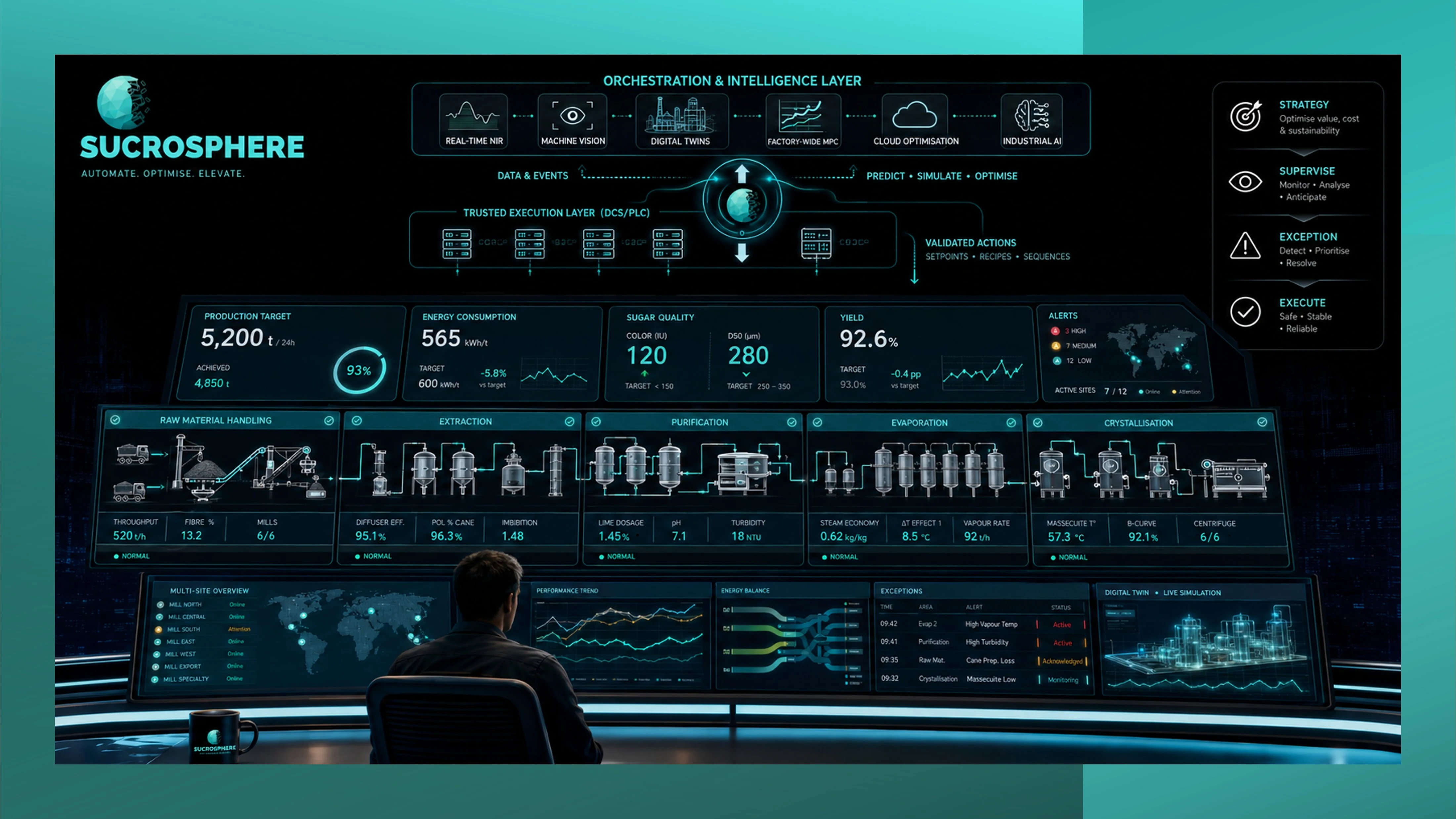
The coordination layer is a control layer above the process MPCs. It does not replace them, and it is not one giant model of the entire factory.

It takes the production targets: tonnes of white sugar, the quality grade to hit, the steam budget, the planned stops, and translates them into objectives and constraints for each process MPC. It reads back what each unit can actually deliver in the state it is in right now. Then it does the arithmetic nobody can do reliably in their head: which combination of local objectives produces the best factory result, updated as the day moves.

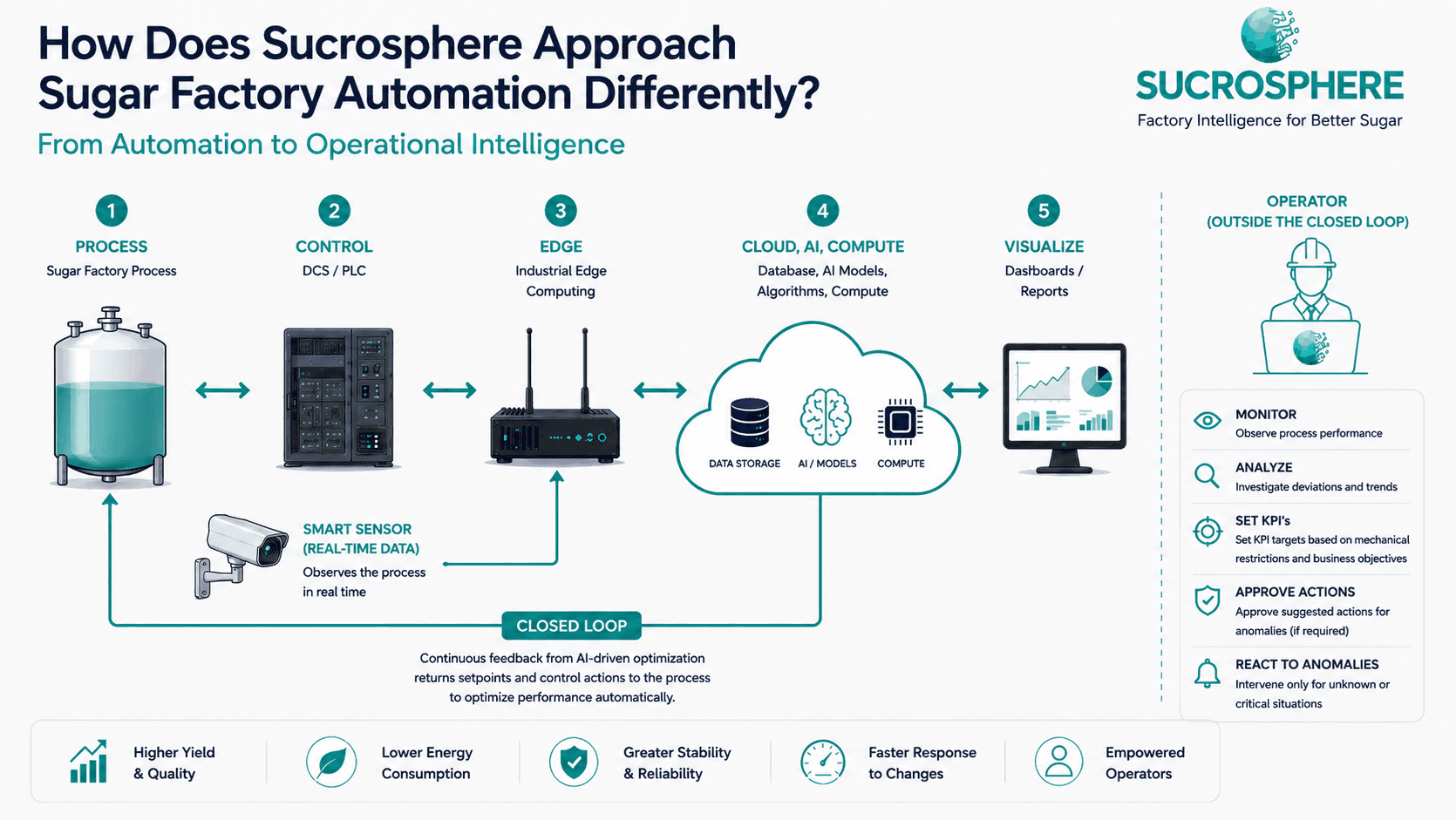
The shape of it will be familiar to anyone who has worked with a DCS: it is a control cascade, 1 level further up. The top controller sets setpoint objectives for the controllers below it, and those ripple down. MPC sets targets for the PLC loops without taking over the loops, and the coordination layer sets objectives for the MPCs without taking over the MPCs. Each level works at the timescale it is good at: a PID loop in milliseconds, a process MPC every few seconds to a minute, the coordination layer over hours.

The cascade also answers the first question every plant manager asks. Any single controller can be disconnected and the level below it keeps working. Take the coordination layer out and you are back to the process MPCs you had before.

Hours is the interesting part of that list. It is where a sugar factory actually loses money, and exactly the horizon no single controller was ever given responsibility for.

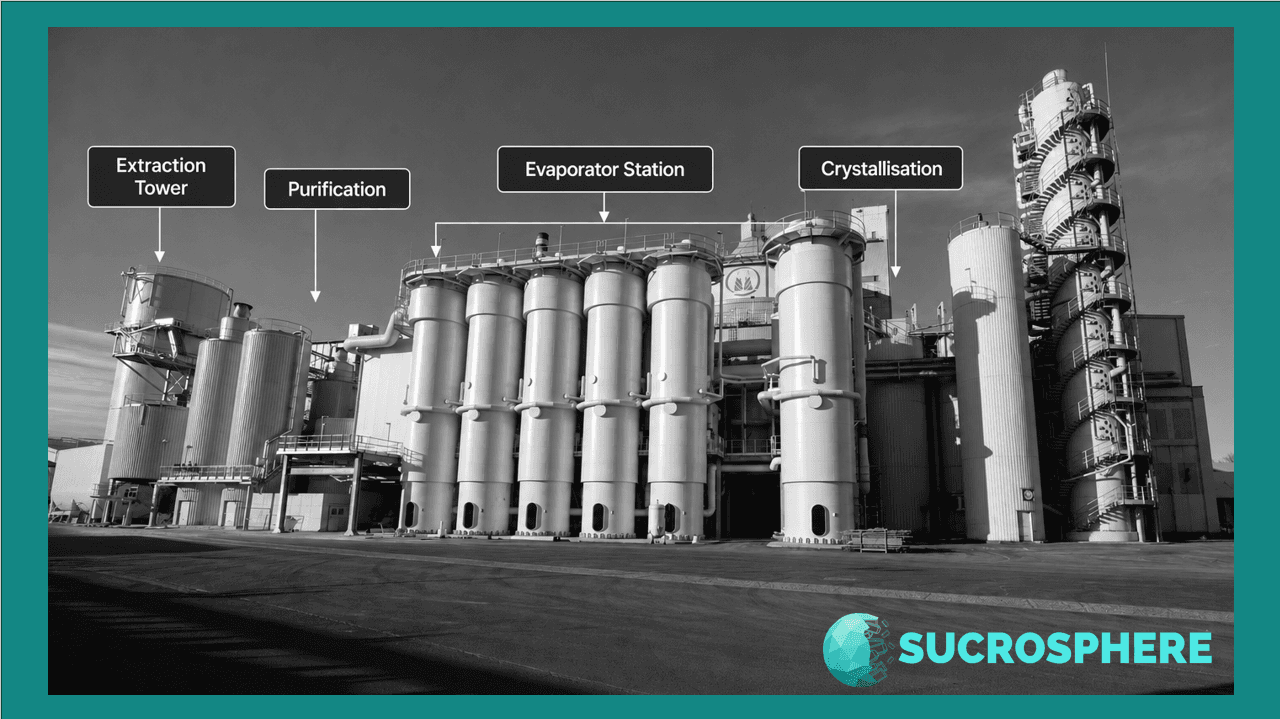
How Do Extraction, Purification, Crystallisation, and Scheduling Connect?

In extraction, the coordination layer picks the objective mode instead of leaving it to whoever was in the control room. When the sugar house is the bottleneck, there is no point pushing recovery upstream; the better move is to send purification a cleaner juice.

The purification MPC simultaneously coordinates multiple chemical dosing, recycle, and temperature variables. It hits the juice quality it was asked for, and it has no way of knowing that the load arriving from extraction will change in 40 minutes, unless something tells it.

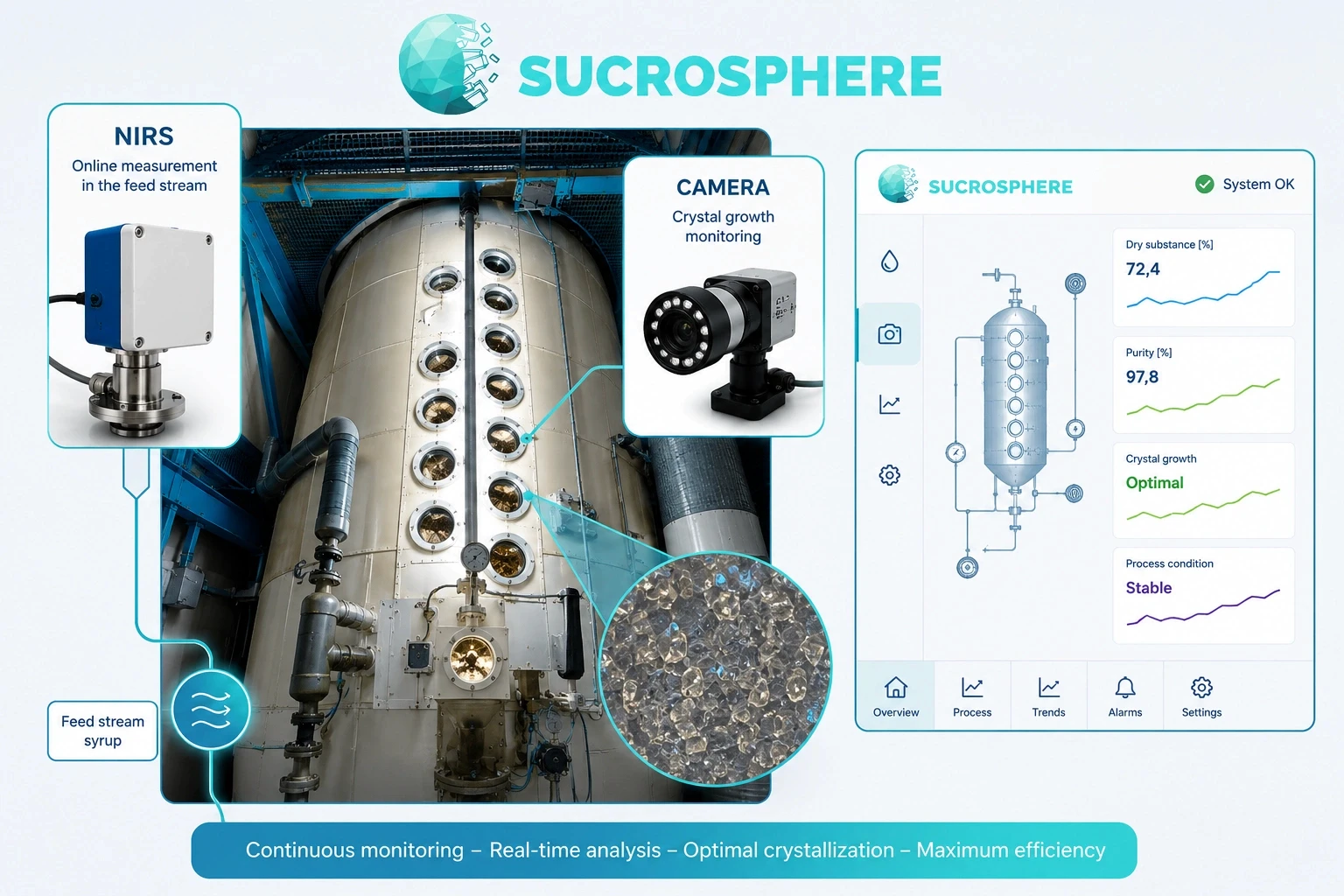
In crystallisation, the controller stabilises supersaturation using process models together with vision and near-infrared measurements. Its constraint is rarely the chemistry. It is the thick juice available, the pan that is still occupied, or the level in the strike receiver.

Scheduling is the part people underestimate. It decides when a strike starts, which crystalliser and which centrifuge it occupies, and for how long, which means a decision taken now blocks equipment for hours. The scheduler uses the current and predicted state of tanks, crystallisers, and centrifuges. It is where the factory's time dimension becomes explicit.

The mechanism that ties these together is simpler than it sounds: the coordination layer uses forward-looking information from each process area, so downstream controllers can prepare before the changes arrive. Extraction publishes where it expects to be in an hour. Purification can then treat that as a forecast disturbance it plans around, instead of a surprise it reacts to. Every one of these controllers is already predicting the future for its own use. Coordination mostly means letting the others read it.

What Changes When the Factory Has a Single Objective?

The trade-offs stop being implicit.

Right now they are being made, constantly, by whoever set a mode or a setpoint last, without anyone writing down what was traded for what. With a coordination layer, the trade-off is made once, at the top, against a stated target, and every unit works to the same definition of better.

The system will not invent a preference for you. If production, process engineering, and management do not agree on whether today is a throughput day or an energy day, the coordination layer has nothing to optimise towards. We wrote in our post on the shift from PID to MPC that the hard part of these projects has never been the mathematics. A coordination layer makes that unavoidable, which we consider a feature.

That agreement also has to take a concrete form, and the form is a single plant-level KPI system rather than 1 set of numbers per department. This is the unglamorous prerequisite, and usually the piece a factory has not built.

Where Is This Today?

The process MPCs are production reality. MPC runs on 6 extraction towers across 4 factories, and during the last campaign 1 of those controllers ran for 65 consecutive days without manual intervention.

The coordination layer above them is not at that stage. First integration tests are running, and the scheduling work runs alongside the existing system rather than in place of it, so that we can compare the 2 against real data instead of against a simulation. The architecture is defined and the first integration tests are underway.

Extraction, purification, and whole-chain scheduling come first, and the layer that coordinates them comes last. Coordinating controllers that are not yet finished would mean optimising a factory we cannot yet fully operate. A campaign is 100 to 150 days of continuous running, and every stopped hour is beet you cannot get back, so nobody sensible switches the factory's decision logic over in week 6 to see what happens.

An emerging capability with a settled architecture, not a finished product.

What Will Full Factory Coordination Look Like?

Production planning states what the factory should deliver this week. The factory works out how, across every stage, and keeps working it out as the beet and the equipment change under it. Operators supervise the factory rather than a set of units, and the questions that reach them are the ones a model was never told about: a fouled heat exchanger, a bad delivery of beet.

The part that matters commercially is that this is portable. A coordination layer built on process models rather than on 1 plant's wiring can move to the next factory, which is the difference between a project and a platform.

Want to See the Deployment Results?

The deployment methodology and results from our extraction and crystallisation projects are in the Sucrosphere white papers.

Frequently Asked Questions

Is the coordination layer a replacement for our MES or planning system?

No. It sits between the planning system and the process control. The planning system decides what the factory should produce; the coordination layer works out how the process units should be operated to deliver it.

Do we need MPC on every process area before this is useful?

No, but you need more than 1. The value comes from resolving conflicts between units, so there have to be at least 2 units capable of taking an objective. Most factories start with extraction or crystallisation and add from there.

Is this a bigger MPC controlling everything?

No. 1 model of an entire factory would be neither solvable in time nor maintainable. The coordination layer sets objectives and constraints for the process MPCs, and each of those keeps solving its own problem.

What happens if the coordination layer goes down, or a unit is out of service?

2 cases, 1 answer: the cascade. If the coordination layer stops, the process MPCs keep running on their last objectives and the factory operates the way it does today. If a unit is out of service, it becomes a constraint at the coordination level and the targets for the remaining units are recomputed against what is available.

Can we see it running today?

Parts of it. The process MPCs are in production across several factories, and the coordination layer is in integration testing. Get in touch if you want to look at where it stands.
About the author

Loïc d’Anterroches, PhD

Lead Modeling Expert at Sucrosphere, Pfeifer & Langen IP GmbH. Loïc is a PhD chemical engineer with over 25 years solving complex property modeling and dynamic simulation challenges across the sugar, chemical, and industrial sectors. He designed the process models behind Sucrosphere’s MPC systems. sucrosphere.com/about

READ MORE ARTICLES

READ MORE ARTICLES

PLATFORM / AUTOMATION

What Is Sucrosphere's Factory Coordination Layer, and Why Does It Matter?

A well-tuned MPC on every stage and the factory can still run below what it is capable of. Here is why, and what the coordination layer above the MPCs actually does.

PLATFORM / AUTOMATION

What Is Sucrosphere's Factory Coordination Layer, and Why Does It Matter?

A well-tuned MPC on every stage and the factory can still run below what it is capable of. Here is why, and what the coordination layer above the MPCs actually does.

EVENTS / INDIA

Sucrosphere at STAI 2026 Goa: From Digitalisation to Autonomous Sugar Factory Operations

Mark O. Burkhardt and Wolfgang Klosterhalfen will present at the STAI Conference in Goa, India, 18 to 20 August 2026.

EVENTS / INDIA

Sucrosphere at STAI 2026 Goa: From Digitalisation to Autonomous Sugar Factory Operations

Mark O. Burkhardt and Wolfgang Klosterhalfen will present at the STAI Conference in Goa, India, 18 to 20 August 2026.

AUTOMATION / PROCESS CONTROL

From Reactive to Predictive: How the Sugar Industry Is Moving Beyond PID Control

The tool that got sugar factories here is not the tool that takes them further. Here is what changed, why it took this long, and what the shift to MPC actually looks like.

AUTOMATION / PROCESS CONTROL

From Reactive to Predictive: How the Sugar Industry Is Moving Beyond PID Control

The tool that got sugar factories here is not the tool that takes them further. Here is what changed, why it took this long, and what the shift to MPC actually looks like.

NEWS / TEAM

Dr. Arend Wittenberg Joins the Management Team of Pfeifer & Langen IP GmbH

30+ years in the international sugar industry. Former Managing Director of BMA Group. Now focused on building Sucrosphere's global reach.

NEWS / TEAM

Dr. Arend Wittenberg Joins the Management Team of Pfeifer & Langen IP GmbH

30+ years in the international sugar industry. Former Managing Director of BMA Group. Now focused on building Sucrosphere's global reach.

SERIES: SUGAR FACTORY AUTOMATION 2026 / PART 3

The Autonomous Sugar Factory: Scenarios for the Next 5 Years

By 2031, sugar factories will face 3 realistic scenarios: conservative DCS evolution, AI-assisted operations as standard...

SERIES: SUGAR FACTORY AUTOMATION 2026 / PART 3

The Autonomous Sugar Factory: Scenarios for the Next 5 Years

By 2031, sugar factories will face 3 realistic scenarios: conservative DCS evolution, AI-assisted operations as standard...

SERIES: SUGAR FACTORY AUTOMATION 2026 / PART 2

From Automation to Optimisation: MPC, Sensors, and Real Campaign Value

Part 1 showed why classic DCS stability is no longer enough. Part 2 goes deeper: which technologies are proven in real...

SERIES: SUGAR FACTORY AUTOMATION 2026 / PART 2

From Automation to Optimisation: MPC, Sensors, and Real Campaign Value

Part 1 showed why classic DCS stability is no longer enough. Part 2 goes deeper: which technologies are proven in real...

SERIES: SUGAR FACTORY AUTOMATION 2026 /PART 1

Where Sugar Factory Automation Stands in 2026

Where the industry stands, where it is going, and why Sucrosphere becomes the sugar-specific optimisation layer.

SERIES: SUGAR FACTORY AUTOMATION 2026 /PART 1

Where Sugar Factory Automation Stands in 2026

Where the industry stands, where it is going, and why Sucrosphere becomes the sugar-specific optimisation layer.

CRYSTALLISATION

A Data-Driven Approach to Optimising Batch Sugar Crystallisation

How Smart Crystal Control combines real-time sensing, model-based control, and self-tuning to make crystallisation transparent, adaptive, and progressively autonomous.

CRYSTALLISATION

A Data-Driven Approach to Optimising Batch Sugar Crystallisation

How Smart Crystal Control combines real-time sensing, model-based control, and self-tuning to make crystallisation transparent, adaptive, and progressively autonomous.

INFORMATION

When the Tower Won't Listen: Automated Pressure Protection for Beet Extraction

An MPC-integrated pressure protection logic that absorbs beet extraction tower overpressure automatically, cutting...

INFORMATION

When the Tower Won't Listen: Automated Pressure Protection for Beet Extraction

An MPC-integrated pressure protection logic that absorbs beet extraction tower overpressure automatically, cutting...

PHILOSOPHY

How Does Sucrosphere Approach Sugar Factory Automation Differently?

Sucrosphere approaches sugar factory automation as a connected factory intelligence platform rather than a collection of point solutions. Built on 150 years of Pfeifer & Langen...

PHILOSOPHY

How Does Sucrosphere Approach Sugar Factory Automation Differently?

Sucrosphere approaches sugar factory automation as a connected factory intelligence platform rather than a collection of point solutions. Built on 150 years of Pfeifer & Langen...

CONFERENCE

Sucrosphere at UPSMA 2026: 3 Steps from Automation to Autonomous Operation

Sucrosphere is presenting at the UPSMA 2nd International Conference on Future Ready Sugar Industry in Lucknow, India...

CONFERENCE

Sucrosphere at UPSMA 2026: 3 Steps from Automation to Autonomous Operation

Sucrosphere is presenting at the UPSMA 2nd International Conference on Future Ready Sugar Industry in Lucknow, India...

CONFERENCE

Sucrosphere at VDZ/ESST 2026: MPC, Smart Crystal Control, and the Autonomous Sugar Factory

On Day 1 of the 9th VDZ/ESST Conference in Lubeck, Sucrosphere presented live results from 2 deployed systems: MPC-based...

CONFERENCE

Sucrosphere at VDZ/ESST 2026: MPC, Smart Crystal Control, and the Autonomous Sugar Factory

On Day 1 of the 9th VDZ/ESST Conference in Lubeck, Sucrosphere presented live results from 2 deployed systems: MPC-based...

AUTOMATION

Sugar Factory Automation Checklist: 10 Signs You Are Ready to Implement MPC

A sugar factory is ready to implement Model Predictive Control (MPC) when it has OPC-UA connectivity, a process engineer who understands...

AUTOMATION

Sugar Factory Automation Checklist: 10 Signs You Are Ready to Implement MPC

A sugar factory is ready to implement Model Predictive Control (MPC) when it has OPC-UA connectivity, a process engineer who understands...

EXTRACTION OPTIMIZATION

Smart Extraction Control: How VSS, NIRS, and MPC Are Redefining Sugar Recovery

Smart Extraction Control combines a Visual Smart Sensor (VSS) for cossette quality, NIRS sensors across all extraction streams, and...

EXTRACTION OPTIMIZATION

Smart Extraction Control: How VSS, NIRS, and MPC Are Redefining Sugar Recovery

Smart Extraction Control combines a Visual Smart Sensor (VSS) for cossette quality, NIRS sensors across all extraction streams, and...

EVENT RECAP

Smart Crystal Control

Smart Crystal Control is an integrated system that uses a Visual Sensor System (VSS) and NIR spectroscopy to measure crystal population and feed syrup quality in real time, and a model-based...

EVENT RECAP

Smart Crystal Control

Smart Crystal Control is an integrated system that uses a Visual Sensor System (VSS) and NIR spectroscopy to measure crystal population and feed syrup quality in real time, and a model-based...

INFORMATION

What Is Model Predictive Control (MPC) in Sugar Production?

MPC is a software layer that uses a mathematical model of your process to calculate the optimal control actions for the next hour, not just the next setpoint. It manages...

INFORMATION

What Is Model Predictive Control (MPC) in Sugar Production?

MPC is a software layer that uses a mathematical model of your process to calculate the optimal control actions for the next hour, not just the next setpoint. It manages...

OPTIMIZATION

NIR Spectroscopy in Sugar Processing - Real-Time Sugar Monitoring

NIRS has evolved from a laboratory technique into a core enabler of real-time process control in modern sugar production.

OPTIMIZATION

NIR Spectroscopy in Sugar Processing - Real-Time Sugar Monitoring

NIRS has evolved from a laboratory technique into a core enabler of real-time process control in modern sugar production.

COST REDUCTION

5 Hidden Costs Killing Sugar Production Profits (How to Fix)

Discover five hidden costs draining sugar production profits and proven solutions to reduce expenses by €400K per campaign using automation

COST REDUCTION

5 Hidden Costs Killing Sugar Production Profits (How to Fix)

Discover five hidden costs draining sugar production profits and proven solutions to reduce expenses by €400K per campaign using automation

OPTIMIZATION

How to Increase Sugar Yield: Complete 2026 Optimization Guide

Increase sugar extraction yield by 0.6% using proven process optimization techniques. Learn about NIRS, MPC systems, and IoT integration for sugar plants.

OPTIMIZATION

How to Increase Sugar Yield: Complete 2026 Optimization Guide

Increase sugar extraction yield by 0.6% using proven process optimization techniques. Learn about NIRS, MPC systems, and IoT integration for sugar plants.

NEWS

From Strategy to Shopfloor: How AI Is Delivering Real Value in Sugar Production

Key takeaways from SUCROSPHERE'S AI Roadmap Workshop at the 26th CSI Conference in Marrakesh

NEWS

From Strategy to Shopfloor: How AI Is Delivering Real Value in Sugar Production

Key takeaways from SUCROSPHERE'S AI Roadmap Workshop at the 26th CSI Conference in Marrakesh

INFORMATION

Sucrosphere Extraction Solutions

Boost extraction yield and cut costs. See how our Digital Extraction Package uses MPC and real-time sensors to unlock up to 0.4 €/t in savings.

INFORMATION

Sucrosphere Extraction Solutions

Boost extraction yield and cut costs. See how our Digital Extraction Package uses MPC and real-time sensors to unlock up to 0.4 €/t in savings.

NEWS

MPC deployments: lessons from the last season

From digital twins to verified ROI: we share three critical lessons learned from our recent real-world MPC deployments in sugar factories.

NEWS

MPC deployments: lessons from the last season

From digital twins to verified ROI: we share three critical lessons learned from our recent real-world MPC deployments in sugar factories.

INFORMATION

Carbonatation control that lowers energy use

Stabilize raw juice quality and cut energy costs. Learn how advanced NIR sensors optimize purification today and pave the way for full automation.

INFORMATION

Carbonatation control that lowers energy use

Stabilize raw juice quality and cut energy costs. Learn how advanced NIR sensors optimize purification today and pave the way for full automation.