PROCESS OPTIMISATION / CRYSTALLISATION

Why the Sugar House Bottleneck Is a Scheduling Problem, Not a Capacity Problem

Why the Sugar House Bottleneck Is a Scheduling Problem, Not a Capacity Problem

Why the Sugar House Bottleneck Is a Scheduling Problem, Not a Capacity Problem

Why the Sugar House Bottleneck Is a Scheduling Problem, Not a Capacity Problem

Website developed by Piotr Tyrakowski

How KPI-driven crystallisation scheduling can reveal hidden capacity, smooth steam demand and improve sugar-house performance before new equipment is added.

Before adding pan capacity, the right question is how much more production a factory can achieve with the equipment it already owns. In many sugar factories, the apparent bottleneck is not a shortage of installed capacity but a coordination problem: pans, receivers, centrifuges and steam supply competing for shared resources at the wrong moments. KPI-driven scheduling addresses the timing. The benchmark case for a 10,000 t/d beet factory: +0.2 to +0.5% sugar throughput, up to 10% fewer crystallisation stops, 2.5 to 5% lower sugar-house energy demand, and indicative campaign value of EUR 200,000 to EUR 450,000.

Why This Matters

When a sugar house repeatedly struggles to process incoming syrup, the obvious conclusion is often: we need more pan capacity. That conclusion can be expensive and premature. In many sugar factories, the installed equipment is theoretically capable of handling the required throughput. The problem is that pans, strike receivers, centrifuges, steam supply and downstream equipment do not operate independently. They compete for shared resources, and disturbances in one part of the sugar house propagate into the others.

The result can look exactly like insufficient capacity: pans waiting to discharge, centrifuges overloaded at one moment and underutilised the next, steam demand peaking, strike receivers approaching their limits and operators delaying the start or progress of a batch.

The consequences continue downstream. Irregular discharge from centrifuges creates a fluctuating wet-sugar mass flow to the drying station. A continuously operated dryer must then absorb changing feed loads, making stable operating conditions and final-moisture control more difficult. Residual moisture subsequently released in storage contributes to caking and lump formation in silos. Irregular A-station operation similarly creates a fluctuating feed mass flow to the B-station, forcing the next crystallisation stage to absorb disturbances instead of operating against a steady load.

Before adding another vacuum pan, ask a different question: Is the sugar house really short of capacity, or is the available capacity simply not being used at the right time?

The Symptom Everyone Recognises

Sugar house scheduling optimisation exists to address that question systematically. Consider a beet sugar factory processing approximately 10,000 tonnes of beet per day. On paper, its crystallisation equipment may have enough capacity for the required sugar production. Yet during the campaign, operators repeatedly encounter periods in which the pan station becomes the apparent bottleneck.

One pan is ready to discharge, but strike receivers are too full and there is not enough capacity downstream. Another batch switches from boiling-up to pan-holding, with negative consequences on crystal content and crystal size distribution. Shortly afterwards the feed syrup tank has reached high level, forcing operators to start multiple pans at the same time. Those pans then enter their thickening phase simultaneously, causing a high steam demand peak. In parallel, centrifuges run at maximum capacity to lower strike receiver levels, creating a peak flow of wet sugar and run-off, then wait for product as the pan boiling pattern becomes uneven.

From the control room, the diagnosis seems straightforward: the sugar house needs more capacity. But equipment capacity and effective system capacity are not the same thing. What appears to be a pan, centrifuge or dryer shortage may actually be the accumulated effect of waiting, full tanks, uneven centrifuge loading, steam constraints and downstream restrictions occurring at the wrong moments. Effective capacity depends on whether the individual units are coordinated so that available pan, receiver, centrifuge, steam and downstream capacity can actually be used when needed.

What Actually Causes Pan Station Queuing

A sugar house is not simply a collection of vacuum pans. It is a network of interconnected batch and continuous processes with shared constraints. Pan station queues rarely have a single cause. They develop because several small deviations occur at the same time.

  1. Upstream fluctuations force the sugar house to slow down, without a clear signal for how slow or how long.
  2. Downstream restrictions, such as caking at the dryer inlet or limited conveying capacity, propagate upstream and disrupt pan scheduling.
  3. Disturbances in steam supply reduce evaporation rates and extend batch duration.
  4. Variations in massecuite properties change pan cycle and centrifugation times in ways that are difficult to anticipate from a fixed schedule.
  5. Periodic cleaning of continuous pans temporarily reduces available crystallisation capacity at irregular intervals.
  6. Centrifuges operating below normal capacity create receiver occupancy changes that cascade through subsequent pan starts.

Each event may be manageable on its own. The difficulty comes from their interaction. A delayed centrifuge changes receiver occupancy; the receiver constraint delays a pan discharge; the delayed discharge shifts the next strike start; and several shifted cycles then coincide in a high-steam-demand phase.

This becomes particularly important in sugar houses that combine continuous and batch crystallisation. A continuous pan should ideally change throughput gradually. Abrupt capacity changes can disturb massecuite quality and create equally abrupt changes in steam consumption. Batch pans meanwhile progress through discrete stages. The coordination challenge is therefore larger in mixed continuous/batch sugar houses than in a purely batch configuration.

The scheduling problem is a timing problem: which pan should start when, at what rate should continuous units operate, and what will the resulting load on steam, receivers and centrifuges look like 30, 60 or 90 minutes from now? That question cannot be answered reliably by looking at one pan at a time.

Steam Peaks: The Cost Nobody Attributes to Scheduling

Steam demand makes the interaction especially visible. A batch vacuum pan does not consume the same amount of steam throughout its cycle. Steam demand changes as the pan moves through filling, concentration, seeding, crystal growth, tightening and discharge. If several pans enter high-demand stages simultaneously, their individual steam profiles accumulate into a large sugar-house steam peak.

The consequences extend beyond crystallisation. Evaporation and crystallisation are tightly connected through both material and energy flows. More recent sugar-industry work identifies sugar-house energy input as a key contributor to total factory energy demand, and the absence of steam flow peaks and drops is specifically identified as critical for the efficiency and technical reliability of mechanical vapour compressors.

The idea of smoothing boiling-house steam demand through scheduling is well established in the technical literature. Ramping strategies and coordinated boiling schedules reduce steam-consumption variation in pan boiling. A coordinated schedule can deliberately stagger energy-intensive phases so that instead of several pans competing for steam at once, their cycles are distributed across the available energy envelope.

Steam peak reduction is not only an energy-management problem. It is also a scheduling problem.

How KPI-Driven Scheduling Differs From a Fixed Strike Plan

Traditional scheduling usually starts from experience. Operators know approximate pan cycle times and develop a strike sequence around them. In stable conditions, this works well. The difficulty is that a campaign rarely remains stable. A centrifuge slows down. A pan requires cleaning. Steam pressure falls. Massecuite behaviour changes. A strike takes longer than expected. The dryer becomes temporarily constrained. A fixed schedule loses relevance as soon as actual operation deviates from its assumptions.

KPI-driven scheduling works differently. Instead of asking what the original strike plan says should happen next, it asks: given the current state of the sugar house and what we predict will happen next, which action best supports our production objectives?

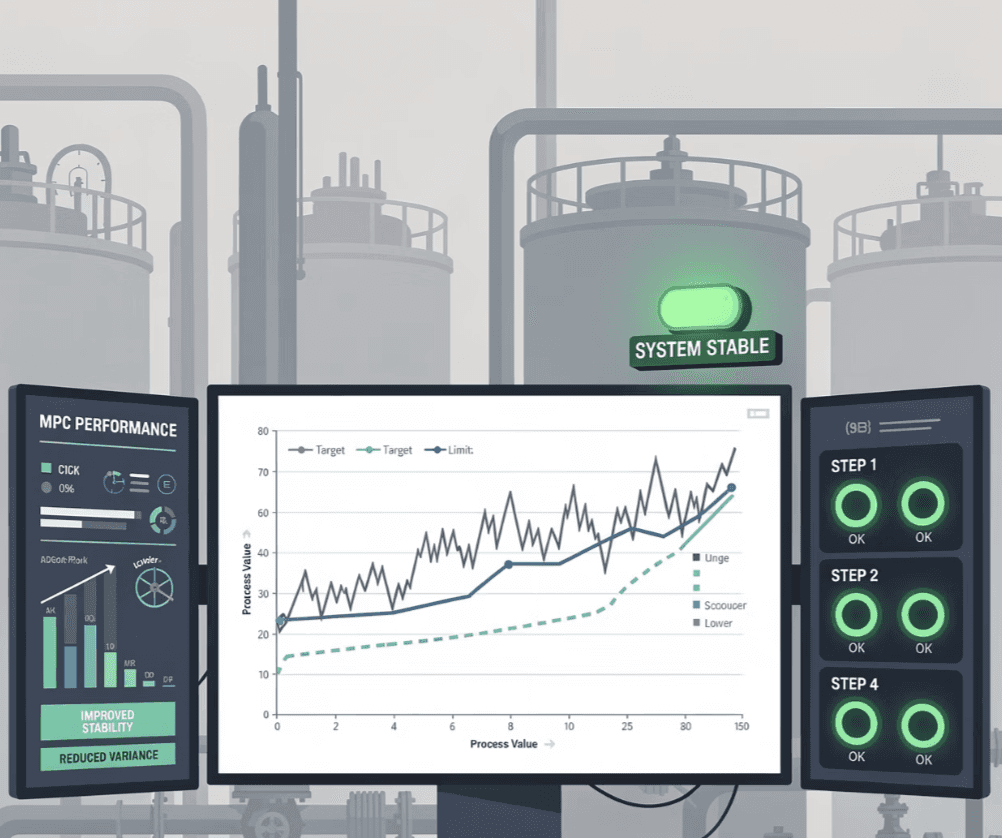
Model Predictive Control (MPC) is well suited to this type of problem because it repeatedly predicts future system behaviour, optimises against defined objectives and constraints, implements the next decision, and recalculates when new information becomes available. MPC and receding-horizon approaches have been applied in the literature to mixed batch/continuous sugar-end operation and scheduling with shared resources.

The Sucrosphere MPC Batch Crystallisation Scheduler applies this principle across the sugar house rather than to a single vacuum pan. Its purpose is to coordinate strike timing, steam demand and throughput while anticipating bottlenecks and synchronising batches. The KPIs reflect what matters most to the factory: maximising throughput, minimising waiting and holding time, reducing steam peaks, protecting receiver limits, maintaining centrifuge utilisation and avoiding unnecessary crystallisation interruptions.

Good pan control ensures that one crystallisation cycle follows the desired trajectory. Good scheduling ensures that all those individually controlled cycles make sense together.

What the Benchmark Data Shows

For a reference beet sugar factory processing approximately 10,000 t/d, the Sucrosphere Crystallisation Scheduler benchmark reports the following indicative results.

Benchmark effect Reported range Operational interpretation
Sugar throughput +0.2 to +0.5% More installed crystallisation and downstream capacity used productively.
Crystallisation stops Up to 10% fewer Conflicts are anticipated before equipment reaches a hard constraint.
Sugar-house energy demand 2.5 to 5% lower Improved coordination and smoother load distribution reduce inefficient operating conditions.
Indicative campaign value EUR 200k to EUR 450k Combined production and energy effect for the stated 10,000 t/d benchmark scenario.

These figures are benchmark results, not universal guarantees. The achievable result depends on factory configuration, campaign length, existing automation, energy costs, product mix, equipment utilisation and, most importantly, how much scheduling inefficiency exists in the starting situation.

The relevant question is not whether every plant can achieve the same percentage. It is: how much hidden capacity does this particular sugar house already have?

When You Genuinely Do Need More Capacity

Scheduling optimisation cannot create unlimited capacity. There are factories where additional equipment is the correct answer. If pans operate close to their physical capacity for sustained periods, centrifuges are continuously highly utilised without substantial waiting losses, steam is available when required, receivers and downstream systems are appropriately dimensioned, and the sugar house still cannot process the required flow, then the constraint may be structural.

Before approving a capacity investment, use plant data to answer six questions.

  1. How much time do pans spend productively crystallising versus waiting?
  2. How often is a pan unable to discharge because the next process step is unavailable?
  3. How evenly are the centrifuges loaded across the campaign?
  4. How often do multiple pans create simultaneous steam peaks?
  5. How frequently do cleaning cycles or equipment disturbances propagate through the complete schedule?
  6. Would a different sequence allow the same equipment to process more product?

If the analysis shows that existing assets are already being used close to their practical limits, additional capacity has a strong technical justification. But if substantial capacity is lost through waiting, conflicting strikes and poorly coordinated shared resources, adding equipment may only make a coordination problem bigger.

Before adding steel, find out whether better timing can release the capacity you already own.

Frequently Asked Questions

What is sugar house scheduling optimisation?

Sugar house scheduling optimisation coordinates the operation of vacuum pans with shared resources such as steam, syrup supply, strike receivers, centrifuges and downstream equipment. The aim is to prevent conflicts before they occur and maximise the effective capacity of the complete sugar house.

Is crystallisation scheduling the same as pan automation?

No. Pan automation controls the crystallisation process inside an individual pan. Scheduling determines how multiple pans and connected equipment should operate together. The two functions complement each other and are both required for a well-coordinated sugar house.

Why use MPC for crystallisation scheduling?

Crystallisation scheduling involves changing conditions, future constraints and competing objectives. MPC uses a process model to predict these developments over a future horizon and continuously recalculates the preferred sequence as plant conditions change. A fixed schedule cannot adapt to disturbances in the same way.

Can scheduling help when a sugar house combines continuous and batch pans?

Yes, and coordination becomes particularly important in this configuration. Continuous equipment should ideally change throughput smoothly, while batch equipment follows discrete cycles. Research on sugar-end control explicitly treats the integration of batch scheduling with continuous process operation as a hybrid plant-wide problem.

Does reducing steam peaks automatically reduce total energy consumption?

Not automatically. Smoothing steam demand and reducing total energy consumption are different objectives. Avoiding conflicting pan cycles can reduce inefficient operating conditions and create a more stable energy balance, but the actual saving depends on the individual factory and needs to be evaluated accordingly.

Should we optimise scheduling before investing in another vacuum pan?

It is worth analysing first. If the existing sugar house frequently suffers from waiting pans, uneven centrifuge loading, receiver constraints or coinciding steam peaks, the apparent capacity problem may at least partly be an operational coordination problem. Only after quantifying that hidden capacity can additional equipment and scheduling software be compared on the same economic basis.

Want to Know More?

The full technical detail, literature references and model architecture behind the Sucrosphere Crystallisation Scheduler are available in the Sucrosphere white papers. The benchmark figures cited in this article are taken from the Sucrosphere Crystallisation Scheduler whitepaper, which reports results for a 10,000 t/d beet factory reference case.

This article is part of the Sucrosphere series on sugar factory process optimisation. Related reading: How to Evaluate a Sugar Automation Vendor: The Questions That Actually Matter, and Device as a Service: How Renting Sensors Changes the Business Case for Optimisation.

About the author

Dr. Arend Wittenberg

Process engineer and sugar industry specialist at Pfeifer & Langen IP GmbH / Sucrosphere. Dr. Wittenberg focuses on crystallisation process modelling, MPC application development and the translation of academic control research into practical sugar factory applications. sucrosphere.com/about

READ MORE ARTICLES

READ MORE ARTICLES

PROCESS OPTIMISATION / CRYSTALLISATION

Why the Sugar House Bottleneck Is a Scheduling Problem, Not a Capacity Problem

How KPI-driven crystallisation scheduling can reveal hidden capacity, smooth steam demand and improve sugar-house performance before new equipment is added.

PROCESS OPTIMISATION / CRYSTALLISATION

Why the Sugar House Bottleneck Is a Scheduling Problem, Not a Capacity Problem

How KPI-driven crystallisation scheduling can reveal hidden capacity, smooth steam demand and improve sugar-house performance before new equipment is added.

AUTOMATION / PROCESS CONTROL

How to Evaluate a Sugar Automation Vendor: The Questions That Actually Matter

Choosing a partner for sugar factory digitalisation means choosing who will help you maintain production when raw material quality changes, measurements drift and the campaign leaves little room for interruption. This framework tells you what to ask and what counts as a real answer.

AUTOMATION / PROCESS CONTROL

How to Evaluate a Sugar Automation Vendor: The Questions That Actually Matter

Choosing a partner for sugar factory digitalisation means choosing who will help you maintain production when raw material quality changes, measurements drift and the campaign leaves little room for interruption. This framework tells you what to ask and what counts as a real answer.

COMMERCIAL MODEL / PLATFORM

Beyond the Sensor: Why a Connected Platform Changes What a Measurement Is Worth

The first post covered the commercial case for renting sensors. This one covers what makes the platform behind them fundamentally different from a device you buy and forget.

COMMERCIAL MODEL / PLATFORM

Beyond the Sensor: Why a Connected Platform Changes What a Measurement Is Worth

The first post covered the commercial case for renting sensors. This one covers what makes the platform behind them fundamentally different from a device you buy and forget.

COMMERCIAL MODEL / INSTRUMENTATION

Device as a Service: How Renting Sensors Changes the Business Case for Optimisation

Why instrumentation keeps getting stuck in capital budgets, and how a different commercial model changes who has to approve it and how long that takes.

COMMERCIAL MODEL / INSTRUMENTATION

Device as a Service: How Renting Sensors Changes the Business Case for Optimisation

Why instrumentation keeps getting stuck in capital budgets, and how a different commercial model changes who has to approve it and how long that takes.

PLATFORM / AUTOMATION

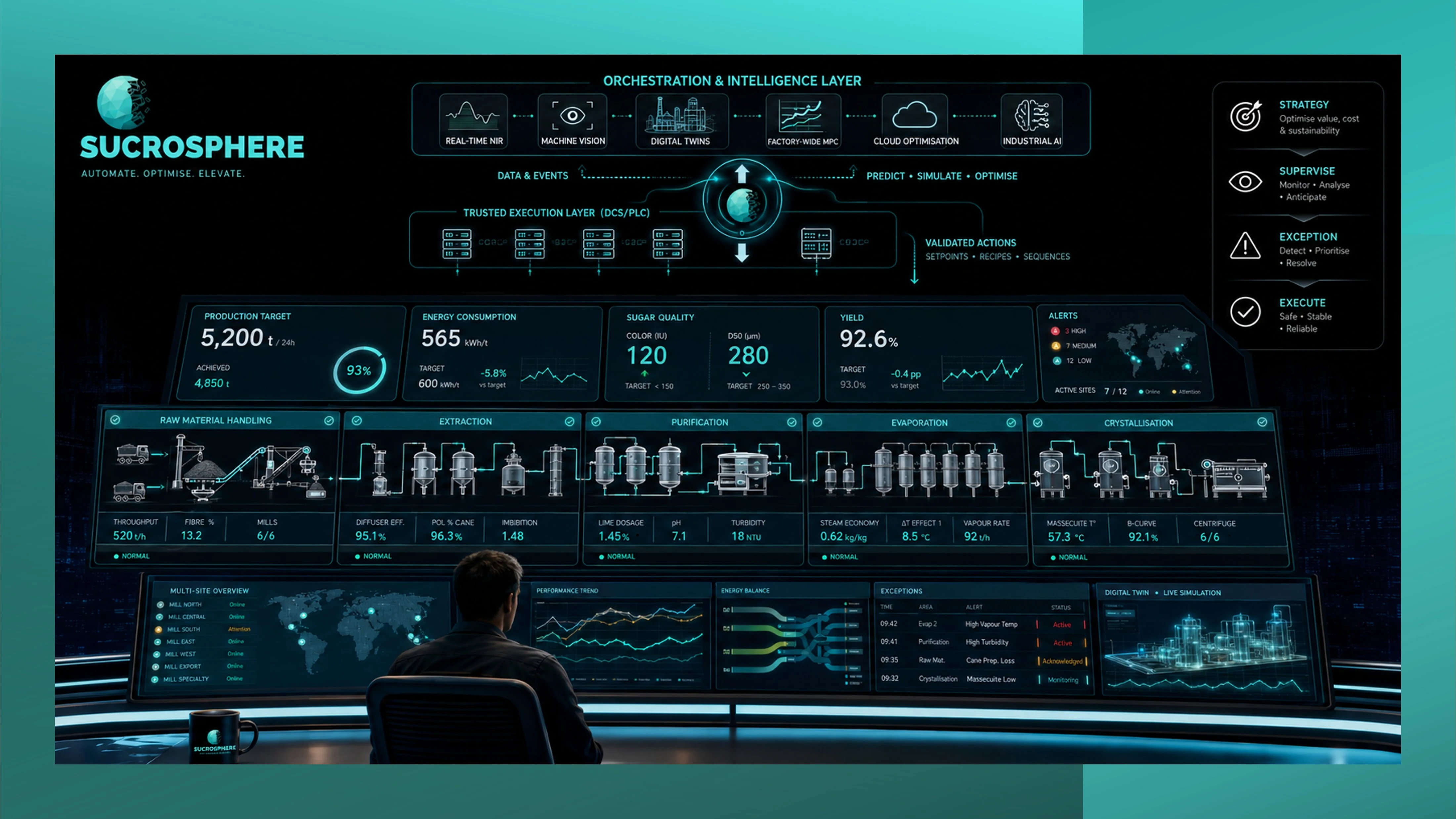
What Is Sucrosphere's Factory Coordination Layer, and Why Does It Matter?

A well-tuned MPC on every stage and the factory can still run below what it is capable of. Here is why, and what the coordination layer above the MPCs actually does.

PLATFORM / AUTOMATION

What Is Sucrosphere's Factory Coordination Layer, and Why Does It Matter?

A well-tuned MPC on every stage and the factory can still run below what it is capable of. Here is why, and what the coordination layer above the MPCs actually does.

EVENTS / INDIA

Sucrosphere at STAI 2026 Goa: From Digitalisation to Autonomous Sugar Factory Operations

Mark O. Burkhardt and Wolfgang Klosterhalfen will present at the STAI Conference in Goa, India, 18 to 20 August 2026.

EVENTS / INDIA

Sucrosphere at STAI 2026 Goa: From Digitalisation to Autonomous Sugar Factory Operations

Mark O. Burkhardt and Wolfgang Klosterhalfen will present at the STAI Conference in Goa, India, 18 to 20 August 2026.

AUTOMATION / PROCESS CONTROL

From Reactive to Predictive: How the Sugar Industry Is Moving Beyond PID Control

The tool that got sugar factories here is not the tool that takes them further. Here is what changed, why it took this long, and what the shift to MPC actually looks like.

AUTOMATION / PROCESS CONTROL

From Reactive to Predictive: How the Sugar Industry Is Moving Beyond PID Control

The tool that got sugar factories here is not the tool that takes them further. Here is what changed, why it took this long, and what the shift to MPC actually looks like.

NEWS / TEAM

Dr. Arend Wittenberg Joins the Management Team of Pfeifer & Langen IP GmbH

30+ years in the international sugar industry. Former Managing Director of BMA Group. Now focused on building Sucrosphere's global reach.

NEWS / TEAM

Dr. Arend Wittenberg Joins the Management Team of Pfeifer & Langen IP GmbH

30+ years in the international sugar industry. Former Managing Director of BMA Group. Now focused on building Sucrosphere's global reach.

SERIES: SUGAR FACTORY AUTOMATION 2026 / PART 3

The Autonomous Sugar Factory: Scenarios for the Next 5 Years

By 2031, sugar factories will face 3 realistic scenarios: conservative DCS evolution, AI-assisted operations as standard...

SERIES: SUGAR FACTORY AUTOMATION 2026 / PART 3

The Autonomous Sugar Factory: Scenarios for the Next 5 Years

By 2031, sugar factories will face 3 realistic scenarios: conservative DCS evolution, AI-assisted operations as standard...

SERIES: SUGAR FACTORY AUTOMATION 2026 / PART 2

From Automation to Optimisation: MPC, Sensors, and Real Campaign Value

Part 1 showed why classic DCS stability is no longer enough. Part 2 goes deeper: which technologies are proven in real...

SERIES: SUGAR FACTORY AUTOMATION 2026 / PART 2

From Automation to Optimisation: MPC, Sensors, and Real Campaign Value

Part 1 showed why classic DCS stability is no longer enough. Part 2 goes deeper: which technologies are proven in real...

SERIES: SUGAR FACTORY AUTOMATION 2026 /PART 1

Where Sugar Factory Automation Stands in 2026

Where the industry stands, where it is going, and why Sucrosphere becomes the sugar-specific optimisation layer.

SERIES: SUGAR FACTORY AUTOMATION 2026 /PART 1

Where Sugar Factory Automation Stands in 2026

Where the industry stands, where it is going, and why Sucrosphere becomes the sugar-specific optimisation layer.

CRYSTALLISATION

A Data-Driven Approach to Optimising Batch Sugar Crystallisation

How Smart Crystal Control combines real-time sensing, model-based control, and self-tuning to make crystallisation transparent, adaptive, and progressively autonomous.

CRYSTALLISATION

A Data-Driven Approach to Optimising Batch Sugar Crystallisation

How Smart Crystal Control combines real-time sensing, model-based control, and self-tuning to make crystallisation transparent, adaptive, and progressively autonomous.

INFORMATION

When the Tower Won't Listen: Automated Pressure Protection for Beet Extraction

An MPC-integrated pressure protection logic that absorbs beet extraction tower overpressure automatically, cutting...

INFORMATION

When the Tower Won't Listen: Automated Pressure Protection for Beet Extraction

An MPC-integrated pressure protection logic that absorbs beet extraction tower overpressure automatically, cutting...

PHILOSOPHY

How Does Sucrosphere Approach Sugar Factory Automation Differently?

Sucrosphere approaches sugar factory automation as a connected factory intelligence platform rather than a collection of point solutions. Built on 150 years of Pfeifer & Langen...

PHILOSOPHY

How Does Sucrosphere Approach Sugar Factory Automation Differently?

Sucrosphere approaches sugar factory automation as a connected factory intelligence platform rather than a collection of point solutions. Built on 150 years of Pfeifer & Langen...

CONFERENCE

Sucrosphere at UPSMA 2026: 3 Steps from Automation to Autonomous Operation

Sucrosphere is presenting at the UPSMA 2nd International Conference on Future Ready Sugar Industry in Lucknow, India...

CONFERENCE

Sucrosphere at UPSMA 2026: 3 Steps from Automation to Autonomous Operation

Sucrosphere is presenting at the UPSMA 2nd International Conference on Future Ready Sugar Industry in Lucknow, India...

CONFERENCE

Sucrosphere at VDZ/ESST 2026: MPC, Smart Crystal Control, and the Autonomous Sugar Factory

On Day 1 of the 9th VDZ/ESST Conference in Lubeck, Sucrosphere presented live results from 2 deployed systems: MPC-based...

CONFERENCE

Sucrosphere at VDZ/ESST 2026: MPC, Smart Crystal Control, and the Autonomous Sugar Factory

On Day 1 of the 9th VDZ/ESST Conference in Lubeck, Sucrosphere presented live results from 2 deployed systems: MPC-based...

AUTOMATION

Sugar Factory Automation Checklist: 10 Signs You Are Ready to Implement MPC

A sugar factory is ready to implement Model Predictive Control (MPC) when it has OPC-UA connectivity, a process engineer who understands...

AUTOMATION

Sugar Factory Automation Checklist: 10 Signs You Are Ready to Implement MPC

A sugar factory is ready to implement Model Predictive Control (MPC) when it has OPC-UA connectivity, a process engineer who understands...

EXTRACTION OPTIMIZATION

Smart Extraction Control: How VSS, NIRS, and MPC Are Redefining Sugar Recovery

Smart Extraction Control combines a Visual Smart Sensor (VSS) for cossette quality, NIRS sensors across all extraction streams, and...

EXTRACTION OPTIMIZATION

Smart Extraction Control: How VSS, NIRS, and MPC Are Redefining Sugar Recovery

Smart Extraction Control combines a Visual Smart Sensor (VSS) for cossette quality, NIRS sensors across all extraction streams, and...

EVENT RECAP

Smart Crystal Control

Smart Crystal Control is an integrated system that uses a Visual Sensor System (VSS) and NIR spectroscopy to measure crystal population and feed syrup quality in real time, and a model-based...

EVENT RECAP

Smart Crystal Control

Smart Crystal Control is an integrated system that uses a Visual Sensor System (VSS) and NIR spectroscopy to measure crystal population and feed syrup quality in real time, and a model-based...

INFORMATION

What Is Model Predictive Control (MPC) in Sugar Production?

MPC is a software layer that uses a mathematical model of your process to calculate the optimal control actions for the next hour, not just the next setpoint. It manages...

INFORMATION

What Is Model Predictive Control (MPC) in Sugar Production?

MPC is a software layer that uses a mathematical model of your process to calculate the optimal control actions for the next hour, not just the next setpoint. It manages...

OPTIMIZATION

NIR Spectroscopy in Sugar Processing - Real-Time Sugar Monitoring

NIRS has evolved from a laboratory technique into a core enabler of real-time process control in modern sugar production.

OPTIMIZATION

NIR Spectroscopy in Sugar Processing - Real-Time Sugar Monitoring

NIRS has evolved from a laboratory technique into a core enabler of real-time process control in modern sugar production.

COST REDUCTION

5 Hidden Costs Killing Sugar Production Profits (How to Fix)

Discover five hidden costs draining sugar production profits and proven solutions to reduce expenses by €400K per campaign using automation

COST REDUCTION

5 Hidden Costs Killing Sugar Production Profits (How to Fix)

Discover five hidden costs draining sugar production profits and proven solutions to reduce expenses by €400K per campaign using automation

OPTIMIZATION

How to Increase Sugar Yield: Complete 2026 Optimization Guide

Increase sugar extraction yield by 0.6% using proven process optimization techniques. Learn about NIRS, MPC systems, and IoT integration for sugar plants.

OPTIMIZATION

How to Increase Sugar Yield: Complete 2026 Optimization Guide

Increase sugar extraction yield by 0.6% using proven process optimization techniques. Learn about NIRS, MPC systems, and IoT integration for sugar plants.

NEWS

From Strategy to Shopfloor: How AI Is Delivering Real Value in Sugar Production

Key takeaways from SUCROSPHERE'S AI Roadmap Workshop at the 26th CSI Conference in Marrakesh

NEWS

From Strategy to Shopfloor: How AI Is Delivering Real Value in Sugar Production

Key takeaways from SUCROSPHERE'S AI Roadmap Workshop at the 26th CSI Conference in Marrakesh

INFORMATION

Sucrosphere Extraction Solutions

Boost extraction yield and cut costs. See how our Digital Extraction Package uses MPC and real-time sensors to unlock up to 0.4 €/t in savings.

INFORMATION

Sucrosphere Extraction Solutions

Boost extraction yield and cut costs. See how our Digital Extraction Package uses MPC and real-time sensors to unlock up to 0.4 €/t in savings.

NEWS

MPC deployments: lessons from the last season

From digital twins to verified ROI: we share three critical lessons learned from our recent real-world MPC deployments in sugar factories.

NEWS

MPC deployments: lessons from the last season

From digital twins to verified ROI: we share three critical lessons learned from our recent real-world MPC deployments in sugar factories.

INFORMATION

Carbonatation control that lowers energy use

Stabilize raw juice quality and cut energy costs. Learn how advanced NIR sensors optimize purification today and pave the way for full automation.

INFORMATION

Carbonatation control that lowers energy use

Stabilize raw juice quality and cut energy costs. Learn how advanced NIR sensors optimize purification today and pave the way for full automation.